🎷 Community High: The Beat That Never Died
From 1970s counterculture to national jazz recognition — how Ann Arbor’s most unconventional public school became a legend.
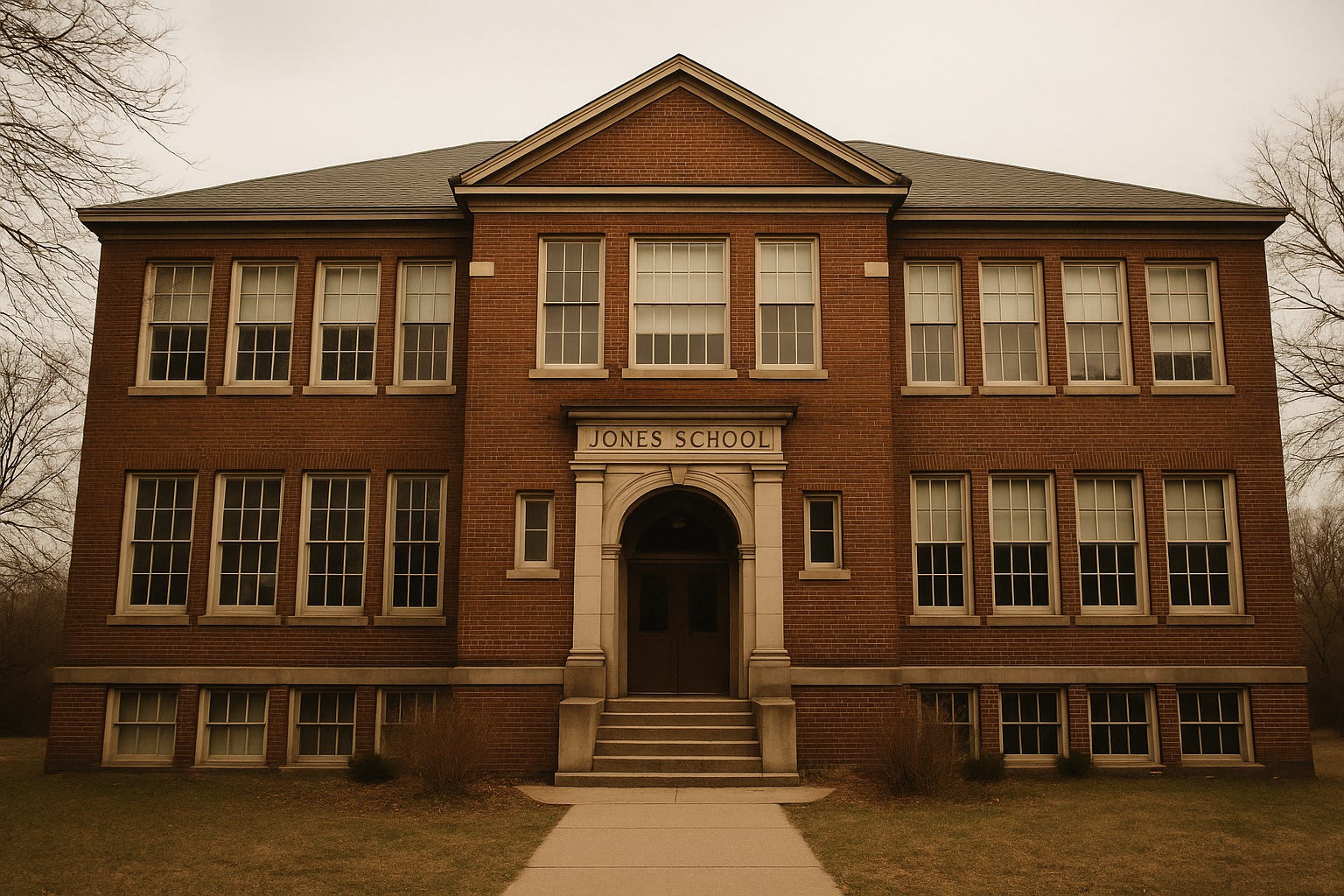
When Community High School opened its doors in 1972, Ann Arbor was buzzing with change. The war in Vietnam had just ended, protest posters still hung in shop windows, and the city’s co-ops and coffeehouses pulsed with new ideas. Into that mix came a public high school that decided to do things differently — no bells, no rigid schedules, no hierarchy between teachers and students.
Locals half-jokingly called it “Commie High.” The name stuck, not as an insult but as a badge of pride.
When my mother came to Ann Arbor at thirteen, she entered a whole new world. In Eagle Harbor she’d gone to a one-room schoolhouse; in Ann Arbor she walked through the doors of Jones School, the city’s first school to serve a diverse downtown neighborhood — the same sturdy brick building that would later become Community High. Decades later, when my son Andy was accepted there, she was thrilled that he’d study in the very halls where her own education had changed course.
Andy didn’t play in the jazz band, but nearly all his friends did. He loved art and English most of all — especially writing, which came easily to him and always carried a streak of humor…and occasional misbehavior. Watching him thrive there reminded me how schools shape us differently when they value curiosity over conformity.
✊ The Spirit of the 1970s
Community High was part experiment, part act of rebellion. Students were trusted to design parts of their own curriculum. Teachers went by first names. Classes sometimes met in coffee shops or downtown bookstores. It was education as community life — messy, personal, and alive.
For students who didn’t fit easily into the larger schools, Community offered belonging. The building, tucked near Kerrytown in the old Jones School, became a refuge for artists, musicians, and free spirits. The emphasis was on learning by doing — journalism, drama, politics, music — not just test prep.
Over time the teasing nickname became affectionate shorthand for what made the place special: collaboration, independence, and conscience. Parents admired that their kids were encouraged to think critically and creatively, not just obediently. Alumni still say it was the first place they felt truly seen.
🎵 The Community High Jazz Program: Freedom and Improvisation in Action
Out of that free-form culture grew something extraordinary — the Community High Jazz Program, founded in the early 1970s and led by Jack Wagner. What began as a handful of students jamming after class evolved into one of the nation’s premier high-school jazz ensembles.
Students didn’t just learn scales and standards. They learned to listen. To improvise. To mentor younger players and rotate leadership the way jazz combos trade solos. Rehearsals became lessons in democracy: every voice mattered, and the groove depended on trust.
By the 1990s the group was performing statewide and nationally — multiple appearances at the Detroit Jazz Festival, honors from DownBeat Magazine, and alumni heading to Berklee, Juilliard, and the University of Michigan. Many now play or teach professionally.
When longtime director Jack Wagner retired, thru the years other great directors picked up the batons, especially Mike Grace from 1980-2008. Even in lean budget years, the program survived thanks to devoted teachers, alumni, and parents who understood that creativity is not an “extra.” It’s the heartbeat of education.
🌱 Legacy and Influence
Community High’s model proved that small, student-centered learning could flourish inside a public system. Its success inspired other AAPS programs:
Ann Arbor Open at Mack, with its multi-age classrooms and family involvement, carries the same democratic DNA.
Skyline High School’s “small learning communities,” launched in 2008, echo Community’s tight-knit forum structure.
Educators from across the country have visited to study how the school balances academic rigor with creative independence — structure without conformity.
Half a century later, Community High School still hums with that improvisational energy. The building has changed, the students have smartphones instead of vinyl, but the philosophy endures: trust young people, give them space to create, and they’ll find their own rhythm.
💬 Closing Note
Ann Arbor has weathered budget shortfalls and program cuts, yet Community High stands as proof that public education can be imaginative, rigorous, and humane all at once. Its jazz band still swings, its students still question authority, and its alumni still smile when they hear someone say, “Oh — you went to Commie High?”
References & Sources
Ann Arbor Observer.
“Welcome to Commie High.” Ann Arbor Observer, May 2022
(A movie review that aired on PBS, in April 2022)IAnn Arbor District Library (AADL) Archives.
“History of Community High.” Old News: Ann Arbor History Collection.
✏️ Author’s Note
This piece is part of a two-part reflection on education and creativity in Ann Arbor. The first, “Community High: The Beat That Never Died,” looks back at the roots of a public-school experiment built on trust and freedom.
The second, “When the Music Stops,” asks what happens when the programs that once defined that spirit — art, music, and curiosity — are the first to be cut.
But Together, they trace a line from a one-room school in Eagle Harbor to Jones School, to Community High, and to the choices we face today.
And the beat goes on, and on, and on.
Just loved learning that history…..I knew some of it. How wonderful that Ann Arbor continues to support that kind of education….there needs to be more of that around the country!!!