Control and Extraction: How Racism Became Policy
From slave patrols and Black Codes to pay-to-stay and family debt, America’s racial caste system has never been accidental — it has always been policy.

Michelle Alexander writes in The New Jim Crow:
“…the problems besetting African American communities are not merely a passive, collateral side effect of poverty, limited educational opportunity or other factors, but a consequence of purposeful government policies.”
That single sentence names what many Americans have tried to deny: the inequities we live with today are not accidental. They were designed, enforced, and written into law. From the earliest slave patrols to today’s militarized police, from the vagrancy laws of the Black Codes to the “pay-to-stay” fees charged in modern jails, the pattern is clear. Control and extraction are not side effects of racism — they are its method.
This is the story of how racial control and financial extraction have traveled together across centuries. First, through policing designed to control Black lives. Second, through incarceration practices that strip Black families of wealth. Put side by side, the throughline is unmistakable: America has long chosen to manage racial hierarchy not just with chains and cells, but also with debts and fees that break families for generations.
⸻
🚨 Policing as Purposeful Policy
The origins of American policing were never neutral. They were designed from the start to control populations deemed threatening to the social order and economic system of the day. For Black communities, this meant a direct line from slavery to modern policing.
1700s–1800s – Slave Patrols: In the South, the first organized policing forces were not about stopping crime but about stopping people. Slave patrols were legally mandated groups of armed white men charged with catching enslaved people who tried to escape, suppressing uprisings, and enforcing racial control. Protecting “property” meant protecting slavery itself.
1800s – Northern Police Forces: In the North, formal police departments emerged in cities like Boston (1838), New York (1845), and Chicago (1851). Their focus was less on slavery and more on class control: guarding commerce, disciplining immigrant workers, and suppressing riots.
Post–Civil War – Reconstruction: With emancipation, the South turned to Black Codes — written laws that criminalized unemployment, travel without permits, or even gathering in public. Police arrested freed people under these laws and funneled them into convict leasing, a system that re-enslaved Black labor under another name.
Jim Crow Era: Police enforced segregation, voter suppression, and racial terror, often collaborating with white supremacist groups to maintain racial hierarchy.
Civil Rights Era: Firehoses, police dogs, mass arrests, and FBI surveillance of Black leaders made clear that law enforcement was being used not to protect freedom, but to suppress it.
Today: Stop-and-frisk, “broken windows,” and militarized policing fall hardest on Black communities — a continuation of centuries of racial control.
Throughline: From slave patrols to militarized policing, the story is consistent. Policing was not designed as a neutral safeguard of public safety. It was designed — and still too often functions — as a system of racial control.
⸻
⚖️ Control and Extraction in Brief
Policing is only one half of the story. The other half is what happens once people enter the justice system. From arrest to release, families are made to carry crushing financial burdens. Put side by side, the pattern is unmistakable: control through policing, extraction through incarceration.
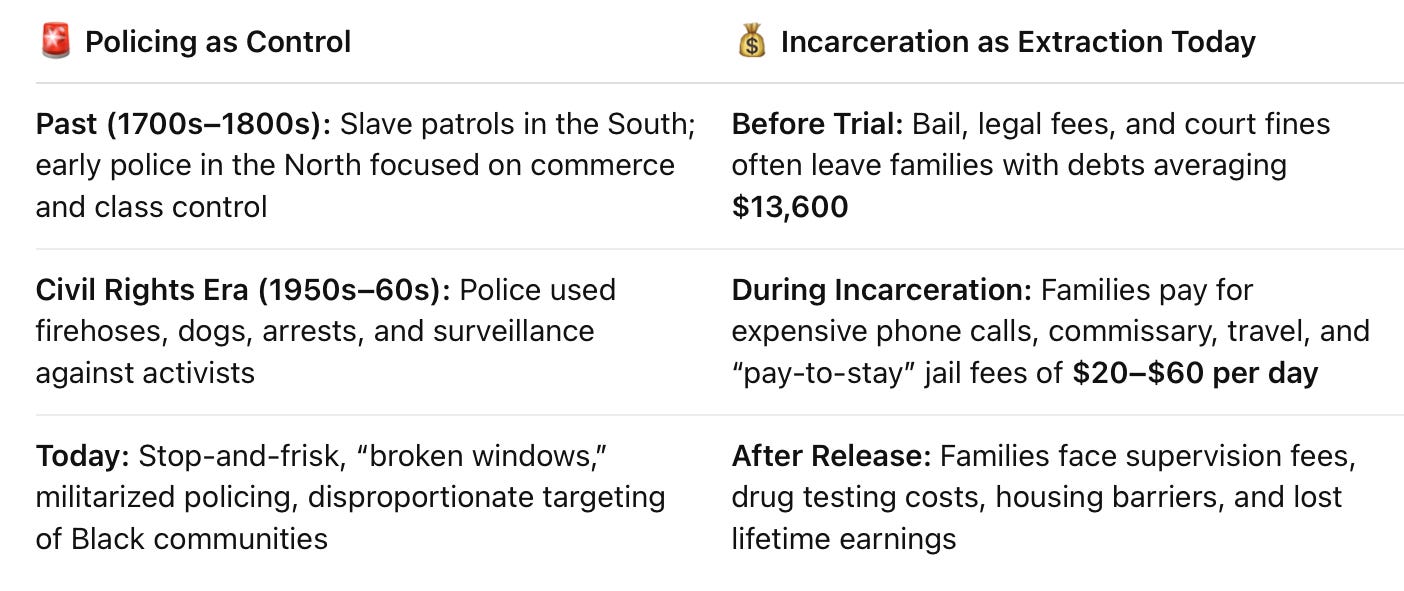
Throughline: These are not accidents. They are purposeful government policies that control Black life on one side and drain Black families’ wealth on the other.
⸻
💰 The Hidden Costs That Break Families
The financial burden of incarceration is staggering, and it falls not on governments but on families. Long before a conviction — and long after release — loved ones are left paying the bill.
Before Trial
Bail/bond: often thousands of dollars.
Attorney fees: $5,000–$50,000+.
Court fines/fees: average $13,600 in debt, even when the accused is found not guilty.
During Incarceration
Phone/video calls: $10–$15 per 15 minutes (before caps).
Commissary & hygiene: families pay for basics prisons fail to provide.
Travel & visitation: gas, hotels, lost wages.
Pay-to-stay: $20–$60 per day in 43 states.
After Release
Supervision & testing fees.
Housing deposits, often denied with bad credit.
Lost lifetime earnings from a criminal record.
Throughline: Incarceration is not just time served — it is money extracted. Families are left carrying debts they can never repay.
⸻
📍 Spotlight on Pay-to-Stay
In 43 states, people are billed for the cost of their own incarceration. Room, board, and even medical care are tallied up like hotel charges — except there is no option to check out.
Daily rate: $20–$60. A three-month sentence can mean thousands in debt.
Collection: Unpaid balances go to collections, damaging credit.
Revenue: Minimal for governments; devastating for families.
Impact: Falls disproportionately on Black families with the least wealth to cushion the blow. It also impacts poor white families.
Throughline: Pay-to-stay is not an administrative quirk. It is the modern echo of convict leasing and debtor’s prison.
⸻
📜 Black Codes — Written Laws of Control
After the Civil War, Southern legislatures quickly passed Black Codes to keep newly freed people under control. These were not informal customs — they were written laws, enforced by police, and designed to funnel Black people back into labor and incarceration.
Mississippi, 1865 — Vagrancy Law
“All freedmen, free negroes and mulattoes … with no lawful employment or business … shall be deemed vagrants, and on conviction thereof shall be fined … and in case of failure to pay said fine … hired out by the sheriff.”
South Carolina, 1865 — Labor Restrictions
“All persons of color who make contracts for service or labor, shall be known as servants, and those with whom they contract, shall be known as masters.”
These laws criminalized unemployment, restricted occupations, and even seized children under “apprenticeship” rules. They were the bridge from slavery to convict leasing — written proof that racism was policy, not accident.
⸻
✊ What We Can Do
End pay-to-stay laws. Push states to repeal daily jail/prison fees.
Reform fines and fees. Support campaigns to abolish abusive court costs.
Cap communication costs. Ensure fair phone/video call rates.
Expand reentry support. Back clean slate laws and community programs.
Build awareness. Share history in study circles, book clubs, and forums.
Throughline: The system was built by policy — and it can be changed by policy.
⸻
And one more system worth mentioning: the same logic of confinement and extraction plays out in immigration detention, where families face crushing costs even without “pay-to-stay.”
🌎 A Parallel System: Immigration
The logic of extraction is not confined to prisons and jails. Immigration detention operates on similar lines.
Daily cost: Taxpayers spend $140–$200 per person per day to keep immigrants in detention, often through private prison contracts.
Family costs: Detainees themselves are not charged “pay-to-stay” fees, but families shoulder inflated phone rates, commissary expenses, and steep immigration bonds (often $5,000–$15,000, paid in full).
Racialized impact: Because most detainees are Latino or Black immigrants, the financial burden falls disproportionately on already marginalized communities.
Throughline: Whether in a county jail or an ICE detention center, the pattern is the same: confinement drains families of money, stability, and hope.
⸻
📚 References
Michelle Alexander, The New Jim Crow (2010).
Brennan Center — Pay-to-Stay Behind Bars.
Fines and Fees Justice Center — Who Pays? The True Cost of Incarceration on Families.
Prison Policy Initiative — The Prison Phone Justice Report.
Wikipedia — Black Codes (United
Wikipedia — Slavery by Another Name
⸻
🔚 Closing
From slave patrols to stop-and-frisk, from vagrancy laws to pay-to-stay, the thread is unbroken. What we see today is not a system gone wrong but a system working exactly as it was designed — to control Black lives and extract Black wealth.
Michelle Alexander’s words bear repeating:
“…the problems besetting African American communities are not merely a passive, collateral side effect of poverty, limited educational opportunity or other factors, but a consequence of purposeful government policies.”
The lesson is clear. If policy built this system, then policy — shaped by collective will, by reform, by persistence — can dismantle it.
Previous Substack: Undoing Racism: Systems, Myths, and Everyday Lives
A question ………..if 43 of the states are doing this practice, what are the 7 states that don’t…..I’d love to know….Thanks!