From Head Start to Higher Ed: The Long March to Reshape American Education
From Head Start to Higher Ed: The Long March to Reshape American Education

The Disappearing Federal Role in Education
Over the last two years, the Trump administration — with guidance from Project 2025’s policy architects — has moved swiftly to dismantle the federal government’s role in education. This isn’t happening in one sweeping law, but in a series of targeted moves that add up to a structural transformation.
The pattern is clear: cut, privatize, and redirect public money toward institutions that align with an ideological vision. What began with early childhood programs and K–12 schools is now moving toward America’s colleges and universities.
Early Childhood: Head Start Under the Knife
One of the earliest moves was the elimination of Head Start, the federally funded preschool program serving low-income families since 1965.
This cut didn’t just remove a pathway to early learning — it pushed the responsibility onto states and private providers, many of which lack the resources or incentive to serve the same children.
The message was unmistakable: early education is no longer a federal priority unless it fits a specific mold.
K–12: Redirecting the Money
Next came the dismantling of the Department of Education — or more accurately, the gutting of its power. Federal oversight of civil rights, disability protections, and Title IX enforcement has been slashed.
At the same time, “school choice” programs expanded, allowing taxpayer dollars to flow to private and religious K–12 schools. These institutions can operate with fewer accountability measures, select their students, and shape curricula without public input.
The result? Public school systems — especially in lower-income communities — lose funding, while private and faith-based schools grow stronger.
Higher Education: The Next Frontier
For months, higher education wasn’t in the headlines. That changed with Columbia University’s $200+ million settlement with the Trump administration — a deal that restored frozen federal research funding in exchange for sweeping policy changes on protests, campus governance, and departmental oversight. Brown University quickly followed with a $50 million settlement, and the University of Pennsylvania made policy concessions.
Critics see a blueprint emerging: use federal research dollars as leverage to force universities into compliance with ideological demands. Those who resist — like Harvard and UCLA — face threats to funding, international student admissions, and even tax-exempt status.
The Project 2025 Playbook.
In its education chapters, Project 2025 outlines three big goals:
Eliminate the Department of Education and end “federal meddling” in local schooling.
Expand public funding for private, charter, and faith-based education at all levels.
Condition federal funding on adherence to “patriotic” and “values-based” curricula.
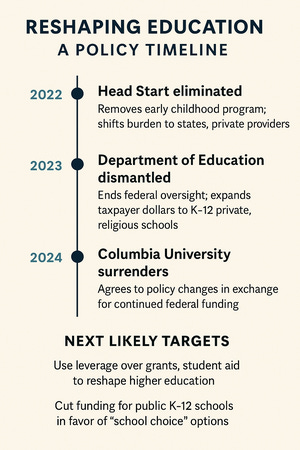
Seen together, the moves from Head Start → K–12 privatization → higher ed pressure are not separate fights — they’re stages of the same campaign.
Why This Matters
If this trajectory continues, the United States could see the federal government’s education role reduced to funding only those institutions that align with a narrow ideological vision, while starving independent public schools and universities.
The danger isn’t just fewer resources — it’s the erosion of academic freedom, equal access, and the idea that education serves the whole public, not just a favored subset.
This isn’t a single battle. It’s a long march. And universities, which once saw themselves as untouchable, may be the next to fall in line.
What We Can Do
1. Name the Pattern, Not Just the Pieces
In every conversation, frame these moves as linked stages of one campaign — not random cuts or isolated policy disputes.
Use the sequence Head Start → K–12 privatization → higher ed leverage so people can remember it.
Share the visual timeline widely so the progression sticks.
2. Support Investigative & Legal Pushback
Groups like the AAUP (American Association of University Professors), PEN America, and Foundation for Individual Rights and Expression (FIRE) are tracking threats to academic freedom and supporting legal challenges.
Civil rights and education watchdogs like Education Law Center and Southern Poverty Law Center are documenting discriminatory funding shifts.
3. Defend Local Public Schools
Attend school board meetings — not just to speak, but to ask questions on the record about voucher impacts and accountability for private schools getting taxpayer funds.
Push for transparency in how state funds are redistributed when public school budgets are cut.
4. Protect Higher Ed Autonomy
Urge universities to form public coalitions with other institutions to resist coercive settlements — lone holdouts like Harvard and UCLA will be stronger if they’re part of a bloc.
Faculty senates and alumni networks can apply pressure internally to reject politically motivated policy changes in exchange for funding.
5. Keep the Public Eye on Funding Leverage
FOIA requests (Freedom of Information Act) can reveal how federal agencies are structuring these settlements and who is crafting the conditions.
Journalists and Substack writers can amplify those details so they can’t quietly become precedent.
References and Further Reading
AP, This preschool in Alaska changed lives for parents and kids alike. Why did it have to close?
Center for American Progress, 5 Things to Know about Head Start
Center for American Progress, Introducing a Framework for Private School Voucher Accountability
The Guardian, Columbia’s capitulation to Trump begins a dark new era for US higher education
AP News, Trump’s settlement with Columbia could become a model for his campaign to reshape higher education
Vox: The Columbia deal with Trump is a blueprint. All of higher ed should fear what comes next.
Yes Columbia University is an Ivy League School, but did you know it is also a Catholic University? They had less incentive to fight a religious ideological based on religion argument than The University of Pennsylvania or some of the State Universities. Here in Michigan, it is incumbent on us to make sure we elect Democratic Board of Governors to each of our State Universities that are willing to fight the battle. Maybe the Big Ten Consortium could fight this together.
Love how you format your newsletters …….so easy to read and ‘get the point’ in all of them….Thanks for doing it this way! Before the election I read sections of Project 2025, and paid particular attention to the Health and Human Services section. It was very alarming to see ‘their plan’. I even told my DIL who wrote a grant for her girls’ elementary school and they received the funds, that there would be no more educational grants! ‘Gotta have those tax breaks for the wealthy’!!!!