How Citizens United Put Democracy on Shaky Ground
How Citizens United Put Democracy on Shaky Ground a Supreme Court Decision Became Structural Damage

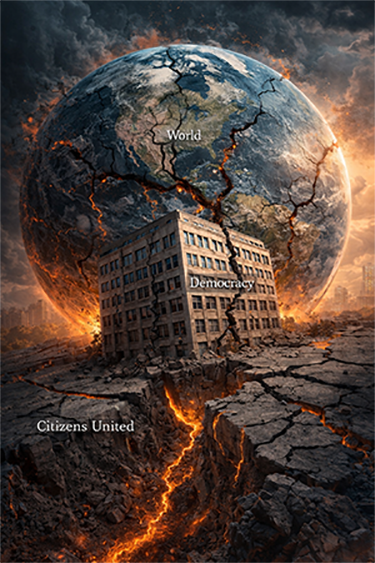
Most people think of Citizens United as a campaign finance case. That description is far too small.
In 2010, in Citizens United v. Federal Election Commission, a 5–4 Supreme Court majority ruled that corporations and outside groups could spend unlimited money in elections, treating that spending as protected speech.
That ruling didn’t just change how elections are paid for. It changed what the political system is built on. It rewired the foundation of the entire structure.
In the image above, the ground is labeled Citizens United. The building is labeled Democracy. The cracks don’t stop at the basement. They run upward, through the structure, and outward into the world.
That’s not exaggeration. That’s what happens when you change a load-bearing rule in a system.
This wasn’t a surface-level policy shift. It was a structural decision.
1. It changed who candidates depend on
Before Citizens United, politicians already raised money. After it, they became dependent on it at a different scale. Not on voters.
On donors.
On billionaires.
On industries.
On organizations that can spend unlimited sums without meaningful transparency.
When your political survival depends on money, your priorities follow the money.
That isn’t corruption in the old sense. It’s architecture.
2. It changed who gets heard
In theory, everyone still has a voice.
In practice, some voices now come with amplification systems that never turn off.
Money buys repetition.
Repetition buys familiarity.
Familiarity buys legitimacy.
What Citizens United did was constitutionalize a volume control on democracy.
Some people whisper. Some interests get surround sound.
3. It changed what laws get written
By the time most legislation is debated, the real decisions have already been made:
In donor meetings
In industry working groups
In lobbyist draft memos
The role of Congress increasingly becomes ratification, not authorship.
That didn’t start with Citizens United. But Citizens United made it dominant.
4. It changed what corruption looks like
We’re trained to look for brown envelopes and secret deals.
That’s not where modern corruption lives.
It lives in:
Legal influence
Legal dependency
Legal capture
Legalized conflicts of interest
When the system is designed this way, nothing looks illegal — and nothing is truly accountable.
5. It changed what the courts are protecting
Citizens United didn’t just allow money in politics. It redefined money as speech and corporations as rights-holders.
That means the courts are no longer just refereeing democracy. They are protecting the machinery that overwhelms it.
6. It changed what is politically possible
Some ideas never get airtime.
Some reforms never get funding.
Some problems become “unrealistic” to even discuss.
Not because voters reject them — but because they don’t fit the donor economy.
This is how a system quietly narrows without ever passing a law that says it is narrowing.
7. It made the damage hard to reverse
Because this wasn’t done by statute. It was done by the Supreme Court.
That means the system itself is now constitutionally protected.
The cracks are not policy problems. They are structural features.
This is not a scandal. It’s an architecture.
And we are living inside what it made possible.
The building in the image isn’t collapsing because someone kicked it. It’s collapsing because its foundation was changed.
That’s what Citizens United did.
What you can do
One of the most practical tools states and cities already use is public financing of elections, which reduces candidates’ dependence on large donors and outside money. A good overview of how this works — and where it’s already in place — is linked in the Brennan Center reference below.
Follow the Montana case closely. It is one of the few serious attempts to attack the problem at the structural level instead of the regulatory level.
In January 2026, the Montana Supreme Court blocked a ballot initiative that would have banned corporate election spending — not because the idea itself was unconstitutional, but because the proposal violated the state’s “single-subject” rule. The court was explicit: this was a procedural ruling. The group behind the measure immediately said it would re-file.
If they win the vote, it could open other states to model the Montana plan.
Daily Montanan. Transparent Election Initiative files new plan to stop corporations from political spending
Brennan Society. Citizens United,Explained
(ACS) Justice in the Balance: Citizens United v. Federal Election Commission
U