Litigation Explosion: Governing by Lawsuit
How the courts became a permanent emergency room — and why taxpayers pay the price.

Every modern president gets sued. That’s normal in a constitutional system.
What is not normal is governing in a way that keeps the federal courts in constant emergency mode: injunctions, rushed appeals, shadow-docket filings, partial rewrites, and repeat litigation.
That is the defining legal pattern of the Trump era.
There is no single public ledger that says, “This cost taxpayers $X billion.” The federal government does not track litigation costs that way. Most of the spending is buried in salaries, agency legal work, and opportunity costs.
But what can be measured — and what actually drives cost — is something just as important:
The scale, speed, and repetition of litigation.
By those measures, the Trump years represent a structural break from modern governance.
This is not normal litigation volume
Every recent president has faced lawsuits. But the number and intensity of cases challenging Trump-era policies are in a different category entirely.
Courts have issued far more nationwide injunctions against Trump policies than against Obama, Biden, or Bush — even accounting for time in office. And in Trump’s second term, that pace accelerated even further.
This matters because nationwide injunctions and emergency cases are the most expensive kind of litigation:
They require immediate, around-the-clock legal work.
They trigger rapid appeals.
They often go straight to the Supreme Court’s shadow docket.
And they frequently restart the entire process when policies are reissued in slightly altered form.
This is not a normal legal workload. It is permanent crisis litigation.
A deeper way to see the problem: constitutional stress
Not all lawsuits are equal.
Some are ordinary disputes over how a statute or regulation is written. Others go much deeper: they ask whether the president or the executive branch has crossed a constitutional boundary — violated due process, overridden Congress’s spending power, ignored federal limits, or claimed authority the Constitution does not grant.
One way to understand what is happening to the legal system right now is to ask a different question:
How often is the Constitution itself being pulled into court as the governing framework?
When you look at recent presidencies through that lens, a clear pattern appears:
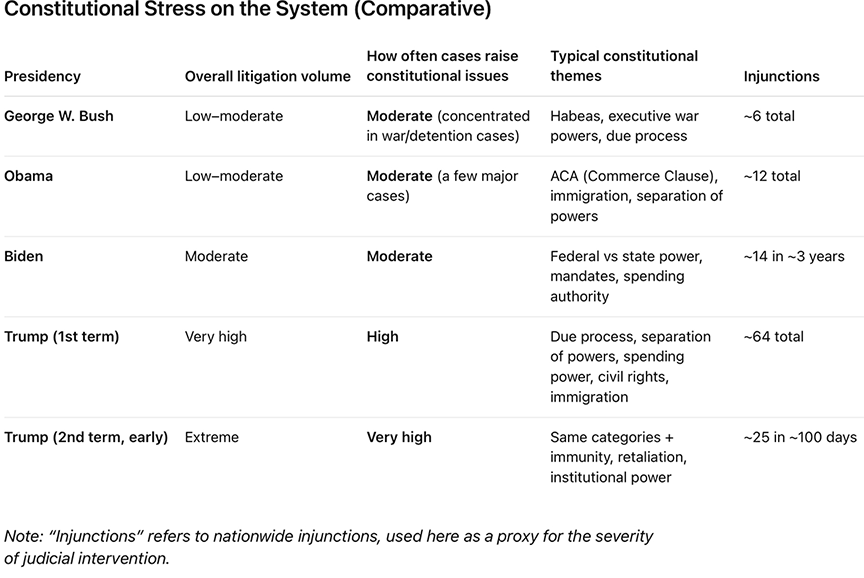
Every modern president encounters constitutional limits. Under George W. Bush, those conflicts clustered around war powers and detention. Under Obama, they appeared in a few major cases involving the Affordable Care Act and immigration. Under Biden, they have centered on federal–state power, mandates, and spending authority.
Under Trump, in both terms, constitutional conflict is no longer episodic. It is constant.
The courts are no longer just refereeing policy disputes. They are being asked, over and over again, to decide basic questions about the structure and limits of executive power itself. That is a very different kind of legal workload — and a very different kind of institutional stress.
And it is exactly this shift — from policy litigation to continuous constitutional confrontation — that turns the legal system into a permanent emergency room.
The litigation loop machine
Here is the pattern that repeats again and again:
A policy is issued quickly, with thin legal preparation.
States, organizations, or affected parties file emergency lawsuits.
A court issues a nationwide injunction.
DOJ rushes to appeal or goes to the shadow docket.
The policy is rewritten slightly.
A new lawsuit is filed.
The cycle starts over.
This is not just litigation. It is repetitive litigation — and repetition is what multiplies cost.
Each loop means:
New briefs
New records
New hearings
New appeals
New Supreme Court filings
All paid for by the public.
Why this burns so much public capacity
Even without a single total dollar figure, the structural damage is easy to see:
DOJ lawyers and agency counsel are pulled into constant emergency work instead of normal governance.
Courts are clogged with high-stakes, fast-moving cases.
Agencies spend months rewriting rules instead of implementing policy.
Other enforcement and oversight work gets delayed or dropped.
This is what governing by lawsuit looks like.
What we can honestly say about money
We can’t say: “This has cost exactly $X billion.”
But we can say:
One state (California) alone spent about $10 million per year suing the Trump administration in his first term.
DOJ’s litigation apparatus costs well over a billion dollars a year in total.
Trump-era litigation volume is hundreds of cases higher than normal.
The most expensive kind of litigation — emergency, nationwide, appellate — has become routine.
And the re-litigation loop multiplies those costs.
This is not “a bit more expensive.”
This is an order-of-magnitude change in how much legal labor the federal government is burning.
The deeper institutional cost
The biggest cost may not even be financial.
It is what this does to the capacity of government itself:
Agencies cannot plan.
Courts are forced into permanent triage.
Law becomes a series of emergency patches instead of a stable framework.
This is not how a functioning constitutional system is supposed to operate.
The bottom line
Every president gets sued.
But no modern president has governed in a way that keeps the federal courts in permanent emergency posture like Trump.
That is not just controversial.
It is structurally expensive, institutionally corrosive, and democratically dangerous.
References
Litigation Tracker: Legal Challenges to Trump Administration Actions
Wbur.org- If Trump broke international law, so what? (Radio)
…..and one of our newspaper’s headline this morning is: “DOJ sues (our state) over voter data access.” That’s always been a state function….not Federal!!