Part I: The Robert’ Playbook
How two decades of rulings have concentrated power and undermined democratic safeguards

For nearly two decades, the Roberts Court has quietly rewritten the rules of American governance. Through headline-making decisions and unsigned midnight orders alike, the Court has expanded presidential power, weakened voting rights, opened the floodgates to money in politics, and tilted the balance of accountability. These moves didn’t happen all at once — they formed a deliberate, cumulative playbook. Whether through precedent-shattering rulings like Citizens United and Dobbs or opaque shadow-docket decisions, the result has been a systematic shift of power upward: to presidents, corporations, and party machinery, and away from democratic checks.
Here’s how that playbook has unfolded — case by case, order by order.
1. Presidential Immunity (2024 ruling)
Case: Trump v. United States (July 1, 2024)
What the Court did: Declared presidents have absolute immunity for core constitutional powers and presumptive immunity for official acts, but no immunity for unofficial acts.
Impact on Trump: This slowed down his federal election-interference trial, forcing Judge Tanya Chutkan to sift through each Trump act (DOJ pressure, Pence pressure, Jan. 6 rally). It’s buying him time and possibly narrowing charges.
Pattern: This creates a precedent that may let future presidents dodge accountability if they frame their actions as “official.”
2. Shadow Docket & Emergency Rulings
The Roberts Court has increasingly used unsigned, unexplained “shadow docket” orders to make major decisions without hearings or reasoning. These orders often reshape the law quietly and quickly.
Examples: The Court has allowed controversial state actions to stand — including election-related measures — without full argument. It has used emergency orders to reinstate or block voting rules just before elections, allow controversial state laws to take effect, and influence immigration, pandemic, and death penalty policies.
Scholars like Stephen Vladeck note that the Court has relied on the shadow docket dozens of times in the last decade, with many orders quietly bending or breaking precedent without explanation.
Impact on Trump: Quick, opaque rulings reduce transparency and delay accountability — helpful to someone fighting legal battles on multiple fronts.
Recent example: In September 2025, the Court used an emergency order to allow the President to fire an FTC commissioner, signaling that the 1935 precedent Humphrey’s Executor may be on the chopping block.
3. Voting & Election Rules
Shelby County v. Holder (2013): Gutted the Voting Rights Act’s preclearance requirement, making it easier for states to change voting rules without federal oversight.
Brnovich v. DNC (2021): Further weakened protections against racial discrimination in voting.
Impact on Trump: These rulings enable restrictive laws that favor Republicans — the party aligned with Trump — by limiting oversight of voting rights.
4. Money in Politics
Citizens United v. FEC (2010): Opened the floodgates to unlimited outside spending in elections.
McCutcheon v. FEC (2014): Struck down aggregate limits on individual campaign contributions.
Impact on Trump: These decisions created an environment where wealthy donors and dark money groups can pour resources into his defense and campaigns, shielding him politically while under indictment.
5. Presidential Power vs. Accountability
Trump v. Mazars (2020): Delayed congressional access to Trump’s financial records.
Trump v. Vance (2020): Allowed New York prosecutors to pursue his tax records but delayed enforcement long enough to blunt immediate impact.
Impact: The Court repeatedly stretched out timelines, giving Trump breathing room until after elections or news cycles passed.
6. Precedent-Breaking on an Unprecedented Scale
Legal scholars estimate that the Roberts Court has overturned or sharply limited more precedents than any modern Court. Examples include:
Citizens United (2010) overturning part of McConnell v. FEC (2003)
Shelby County (2013) effectively gutting South Carolina v. Katzenbach (1966)
Janus v. AFSCME (2018) overturning Abood v. Detroit Board of Education (1977)
Dobbs v. Jackson Women’s Health Organization (2022) overturning Roe v. Wade (1973) and Casey (1992)
By the mid-2020s, the Court has explicitly overturned roughly 20 precedents and weakened many more.
7. The Pattern
Chief Justice John Roberts often positions himself as a moderate, but under his leadership:
Presidential power has been strengthened.
Corporate and wealthy donor influence has expanded.
Voting rights have been weakened.
Transparency and accountability have been reduced.
This doesn’t always look like direct “help” to Trump. But in practice, these rulings delay trials, weaken checks, and strengthen the political forces that protect him. Roberts often sides with the conservative majority, sometimes writing opinions (e.g., Mazars) that appear balanced but still delay or weaken accountability.
Two Tracks of Power: Precedent-Breaking and Shadow Docket
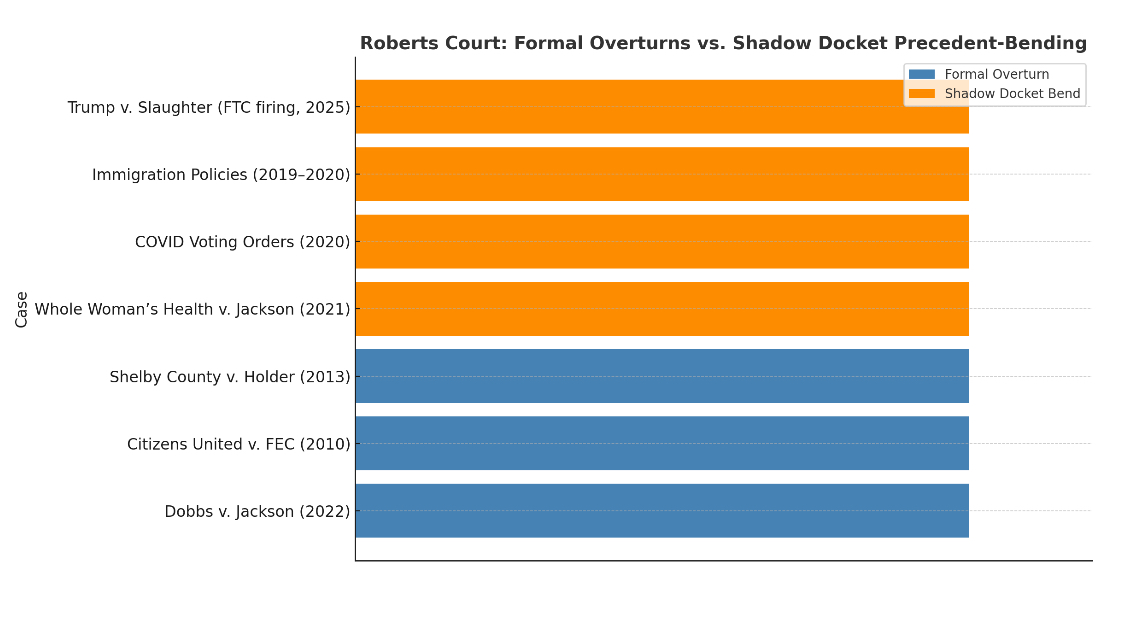
Blue bars: Formal precedent overrulings (Dobbs, Citizens United, Shelby County).
Orange bars: Shadow docket precedent-bending (SB8 abortion case, COVID voting orders, immigration stays, FTC firing).
This shows how the Roberts Court reshapes law along two tracks — sometimes openly overturning precedent, sometimes bending it quietly through emergency orders.
References
Chief Justice Roberts Almost Always Votes to Overturn Precedent (for Partisan Ends) — Take Back the Court
The umpire who picked a side: John Roberts and the death of rule of law in America, The Guardian
In 20 years under John Roberts, a dramatic rightward turn for the US Supreme Court, Reuters
Requiem for the Roberts Court, The Progressive Magazine
The Roberts Court’s quiet revolution didn’t happen overnight. But understanding its playbook is the first step toward defending democratic checks that have been steadily eroded.
This is really informative ………as you stated it didn’t happen all at once, but incrementally so not really arousing suspicion where perhaps we could have stopped some of this. Mitch McConnell really did a number on our country about controlling who could put judges on the court!….so we must get a Democratic congress and President to increase the number of judges to match the number of Federal court districts!
Another notably disastrous upending of precedent by the Roberts court that has utterly changed American life — or, more accurately, American death — is the 2008 Heller decision, grotesquely misconstruing the 2nd amendment.