Series Post 4 — Education: When Learning Becomes a Marketplace
How privatization, secrecy, and political incentives reshape the future — and who gets left behind.

“When public education weakens, the marketplace grows — and children become customers instead of learners.”
1. Introduction: The Quiet Unraveling Of A Public Promise
Public education is one of America’s oldest commitments to the idea of democracy — a system meant to give every child, regardless of income or background, a fair start.
But over the last forty years, public schools have been stretched, starved, criticized, and slowly re-engineered.
Not through one policy, but through an accumulation of decisions:
tax cuts
privatization
vouchers
unfunded mandates
the rise of corporate curriculum and testing
political pressure on school boards
attacks on teachers and librarians
The result is a system that increasingly behaves less like a public good and more like a marketplace.
The shift is slow enough that many people don’t see it. But once you step back, the pattern is unmistakable.
2. How We Got Here: Follow The Funding
Nearly every state in the country spends less per student today than it did two decades ago when adjusted for inflation.
Why?
Tax cuts reduce school budgets
Education is the largest line item in most state budgets.
When tax revenues fall, public schools shrink.
Testing replaced teaching
Beginning in the early 2000s, education policy became increasingly tied to standardized tests.
This opened the door for:
testing companies
curriculum vendors
data-tracking platforms
consulting firms
These companies gained influence while teachers lost autonomy.
Charter schools expanded without guardrails
Originally intended as small, experimental public schools, charters grew into:
multi-state management companies
for-profit operators
real estate investment tools
schools without elected oversight
Vouchers were introduced quietly and grew quickly
Vouchers take public money and give it to private or religious schools.
Over time, this drains funds from public districts.
Public schools are asked to do more with less — and blamed when they struggle.
3. Vouchers: How Public Funds Shift Into Private Hands
The idea sounds appealing in theory:
“Give families choice.”
In practice, vouchers often:
send public funds to private schools that can reject students
reduce funding for public districts
subsidize tuition for families who could already afford private schools
create two separate systems: one public, one private
Most voucher programs do not require private schools to:
hire certified teachers
follow state curriculum standards
accommodate special-education needs
report outcomes publicly
Vouchers look like help. But structurally, they are a pipeline away from public schools — and into private operators.
4. Charter Schools & Private Operators: Where Accountability Weakens
Charters are not all the same.
Some serve students well.
But the structure permits problems:
For-profit management
Some charters are run by corporations seeking returns.
Weakened oversight
Charters often bypass local elected boards.
Enrollment practices that increase segregation
Selective recruitment, limits on special-education students, and mid-year withdrawals all shift costs back to public schools.
High teacher turnover
Many rely on young, underpaid teachers who leave quickly.
Real estate schemes
Some operators lease buildings to themselves at inflated prices, using public money to turn property profits.
If a public school fails, the community sees it.
If a charter fails, the company can close or rebrand — and families are left scrambling.
5. The Rise Of The Education Marketplace
As public schools weaken, the marketplace grows:
standardized testing companies
tutoring corporations
curriculum vendors
software platforms
behavioral-tracking apps
private equity firms buying early-learning centers
Each enters the system with a business model, not a mission.
This shift changes the fundamental question from:
“How do we help children learn?”
to
“What can be monetized?”
And here’s what that looks like in practice…
In Arizona…
📌 Vouchers drained rural districts — and private schools denied entry.
Small public schools lost millions in state funding as voucher enrollment exploded.
Many voucher-receiving private schools do not accept students with disabilities or behavioral needs, leaving public schools with fewer resources and more responsibilities.
In Ohio…
📌 A charter operator charged taxpayers for ‘ghost students.’
A major charter chain inflated enrollment numbers, billing the state for children who did not attend.
The district lost funds; the operator kept the money.
In Florida…
📌 The curriculum marketplace replaced librarians.
Districts facing budget cuts eliminated certified librarians and replaced vetted materials with subscription-based digital content from private vendors.
In Pennsylvania…
📌 A cyber-charter turned high profits while students fell behind.
Virtual charter operators received public funding equal to brick-and-mortar schools — despite significantly lower operating costs and worse academic outcomes.
Nationwide…
📌 Teacher attrition reached historic highs — a system stretched too thin.
Large numbers of teachers leave the profession each year, citing low pay, inadequate resources, and political pressure.
The education marketplace grows as the teaching profession erodes.
6. When Education Erases History
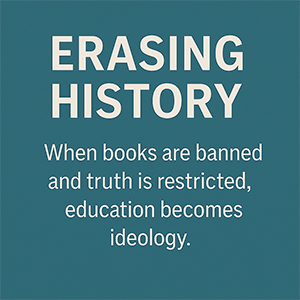
Book bans, curriculum restrictions, and politically motivated censorship have surged nationwide.
Privatization isn’t the only threat to public education.
Control of knowledge is.
Across the country, coordinated efforts have:
removed thousands of books from school libraries,
restricted teaching about race, gender, and American history,
forced librarians to pre-approve every title,
created complaint hotlines that intimidate teachers,
and replaced vetted curricula with ideological rewrites.
This is not about “protecting children.” It is about controlling the story they are allowed to learn.
And here’s what that looks like…
In Texas…
📌 Books on civil rights, Indigenous history, and Anne Frank were pulled from shelves.
Educators described “teaching with one eye on the curriculum and one eye on the complaint hotline.”
In Florida…
📌 Math textbooks were rejected for referencing social-emotional learning.
Some districts wrapped entire library shelves in paper because they weren’t sure which books were permitted.
Nationwide…
📌 Over 4,200 school library books were banned or challenged in 2023–24 — the highest number ever recorded.
Most targeted books were by Black, Latino, Indigenous, Jewish, or LGBTQ authors.
7. Who Profits — And Who Pays
Profits:
voucher schools,
charter management companies,
private curriculum vendors,
testing and assessment corporations,
PACs influencing school board elections,
real estate investors,
consulting firms.
Costs:
underfunded public schools,
rural communities losing local schools,
teachers leaving the profession,
kids receiving uneven, politicized instruction,
taxpayers funding private systems without accountability.
8. What Can Be Done
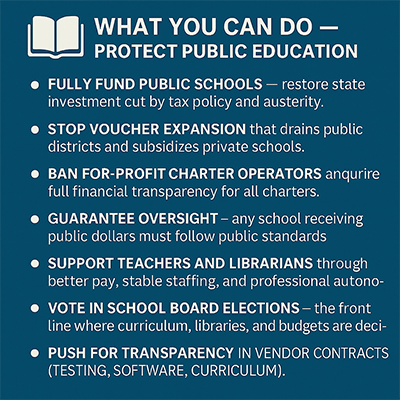
A. Contact State Legislators
To find out how to reach your elected officials
Education policy is shaped in the states.
A simple message matters:
“Fund public schools, limit vouchers, and require transparency for all schools receiving public dollars.”
B. Vote in School Board Elections
They decide:
curriculum
libraries
superintendent leadership
responses to privatization
These are small elections with enormous power.
C. Support Teachers and Librarians
They are the backbone of public education — and under attack.
D. Demand Transparency
Any school receiving public money must disclose:
academic outcomes
finances
teacher qualifications
admissions rules.
E. Watch Local Budgets
Privatization often hides in:
charter leases,
vendor contracts,
voucher allocations.
Numbers reveal truth before rhetoric does.
Closing Reflection
Public education is more than a system. It is a national promise.
When we weaken it — through funding cuts, privatization, book bans, ideological pressure — we weaken the democratic project that depends on informed, empowered citizens.
But nothing described here is inevitable.
These are choices.
And choices can change.
Strengthening public schools strengthens democracy itself.
References
Book Bans & History Erasure
PEN America — Banned in the USA: The Growing Movement to Censor Books
American Library Association — State of America’s Libraries Report