Series Post 5 — Media: How Privatization Was Sold to the Public
How consolidation, ownership, and intimidation reshaped what Americans were told — and what they were never shown

When public goods were turned into private markets, it didn’t happen quietly.
It happened in plain sight — across our newspapers, televisions, radios, websites, and phones.
For forty years, Americans have been told a single story:
Government is inefficient.
Markets are smarter.
Public programs waste your money.
Privatization is common sense.
This story didn’t rise organically from the public.
It was engineered — shaped by media consolidation, billionaire ownership, political intimidation, and a flood of misinformation that blurred the line between fact and propaganda.
Today’s post looks at how the media landscape shifted, who drove those changes, and why it matters for everything from healthcare to prisons to infrastructure.
1. When Six Corporations Controlled Nearly Everything
By the early 2000s, nearly 90% of U.S. media was owned by six companies:
Comcast
Disney
News Corp (Murdoch)
Viacom/CBS
Time Warner
Gannett (local papers)
This concentration meant fewer editors, fewer fact-checkers, fewer investigative teams — and far less diversity of thought.
When the same corporations own:
cable stations
newspapers
film studios
radio networks
streaming platforms
…the incentive shifts from public service to profitability and political expedience.
A democracy needs competing voices. A consolidated media system speaks in one.
2. The Anti-Government Narrative Wasn’t Organic — It Was Manufactured
Beginning in the 1970s, conservative think tanks and corporate lobbying groups deliberately promoted a narrow set of ideas:
Taxes are bad.
Government is incompetent.
Public workers are lazy.
Regulation kills jobs.
Private companies do everything better.
These messages saturated:
opinion columns,
Sunday talk shows,
business news segments,
and local editorials.
Over time, repetition made them feel like common sense.
This softened the ground for privatization:
public schools → charter networks
prisons → for-profit detention
healthcare → insurance-driven gatekeeping
water and parking → private equity deals
infrastructure → toll roads and long-term leases
When people are taught to believe government can’t work, selling it off begins to sound reasonable.
But that belief didn’t come from lived experience — it came from decades of messaging.
3. Who Bought the News? Billionaires, Hedge Funds, and Political Empires
Ownership matters.
Owners shape priorities, influence tone, and quietly determine which stories get pursued — and which never do.
The Washington Post — Jeff Bezos
Bezos bought The Washington Post in 2013.
The newsroom expanded, but coverage of Amazon’s labor practices, antitrust investigations, and unionization efforts became noticeably more restrained.
A paper dependent on the goodwill of one of the richest men on earth is not fully independent.
⸻
The Los Angeles Times — Patrick Soon-Shiong
Initially welcomed as a savior, Soon-Shiong’s ownership soon brought:
major layoffs
shrinking investigative capacity
weakened local coverage
important political stories left untouched
When billionaire interest wanes, public-service journalism withers.
The Hedge Fund Model — Alden Global Capital
Alden acquired and hollowed out dozens of local papers, including:
Chicago Tribune
Denver Post
St. Paul Pioneer Press
Mercury News and many more
Their strategy was simple:
Slash staff
Strip asset
Extract profit
Leave communities uninformed
Many towns now have no watchdogs at all.
Privatization thrives in these shadows.
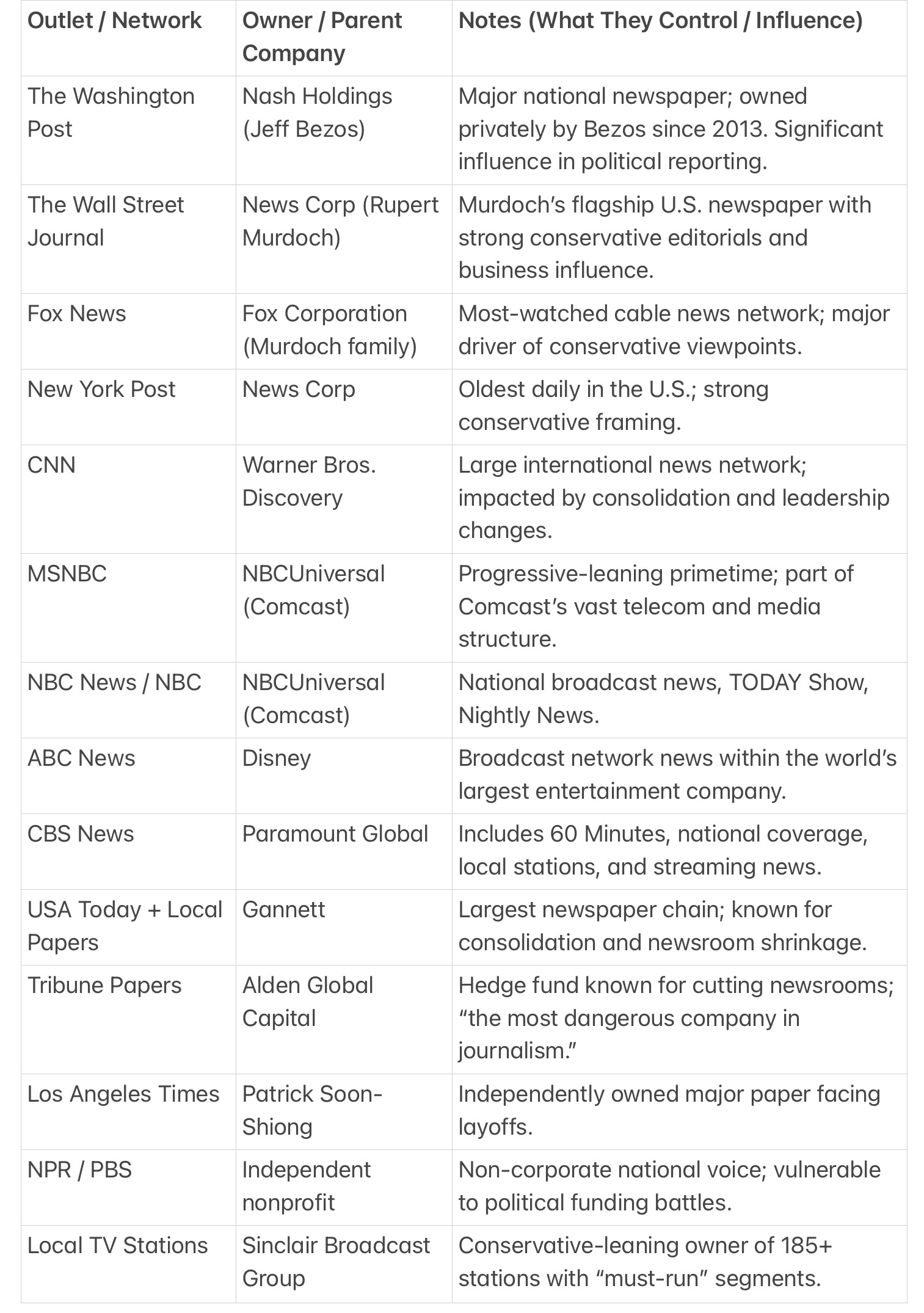
Media Companies and Their Owners
4. The Collapse of Local Journalism Made Corruption Easy
Without local reporters:
Flint’s water crisis took far longer to expose.
Chicago’s 75-year parking meter deal passed with minimal scrutiny.
Ann Arbor’s parking decisions happened with little public awareness.
Dam neglect across the Midwest went largely unreported until failures occurred.
Where reporting disappears, accountability soon follows. What replaces it? Social media outrage, political spin, and corporate public relations.
5. Fox News Rewired the Country — Intentionally
Fox News is not simply conservative. It is an ideological media operation built to shape political reality.
Court records from the Dominion lawsuit revealed that:
hosts knowingly repeated false claims,
executives privately acknowledged those claims were untrue,
truth was sacrificed to retain viewers,
fear and outrage became business strategies.
Fox normalized:
anti-government sentiment
distrust of institutions
conspiratorial thinking
scapegoating
“alternative facts”
This environment made reasoned policy debate nearly impossible.
6. Trump’s Threats Changed Legacy Media — Including 60 Minutes
Trump reshaped media behavior using two tools:
Lawsuit threats. Even weak or frivolous suits impose financial and legal risk.
Public intimidation.
Branding journalists “enemies of the people.”
Singling them out at rallies.
Encouraging harassment.
The result:
60 Minutes and other flagship programs became more cautious.
Language softened — “unfounded claim” replaced “lie.”
CNN’s failed “both-sides neutrality” experiment damaged credibility before leadership reversed course.
Producers avoided stories likely to provoke retaliation.
Fear altered journalism — even at institutions once considered untouchable.
7. And What About MSNBC?
MSNBC is not Fox. It does not fabricate stories.
But under corporate ownership (Comcast), it has become more constrained:
daytime programming grew more cautious,
coverage of corporate power and labor issues narrowed,
some topics were quietly avoided for being “too polarizing.”
MSNBC still does valuable reporting — but within boundaries shaped by advertisers and corporate interests.
It is not disinformation.
It is limited.
8. The Social Media Flood
As Facebook, YouTube, TikTok, and X became primary news sources:
falsehoods spread faster than corrections,
outrage outperformed accuracy,
local issues disappeared,
nuance collapsed,
shared facts eroded.
In this environment, privatization deals proceed quietly. Corporate power grows unchecked. Public understanding fragments.
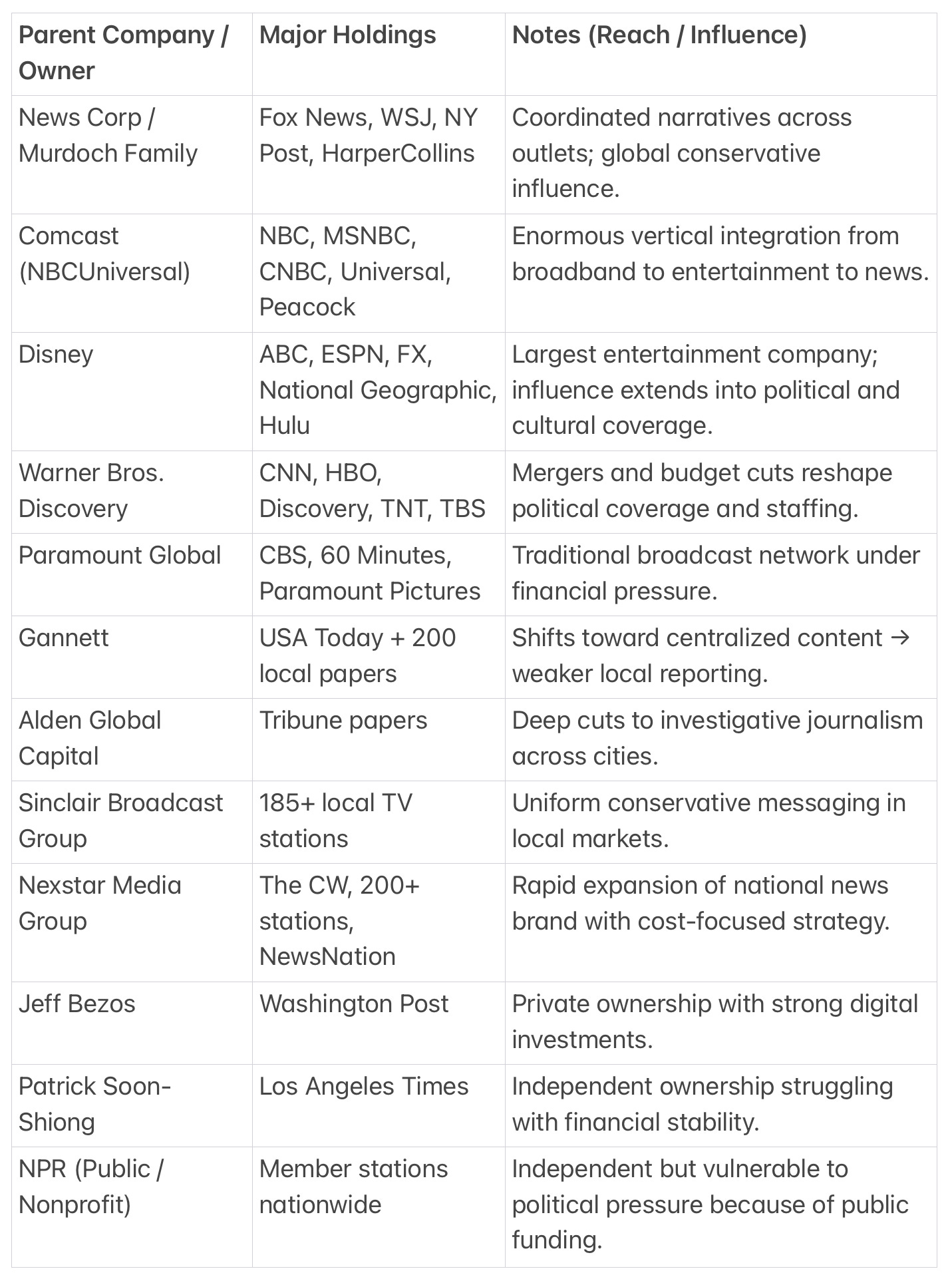
Major U.S. Media Consolidation
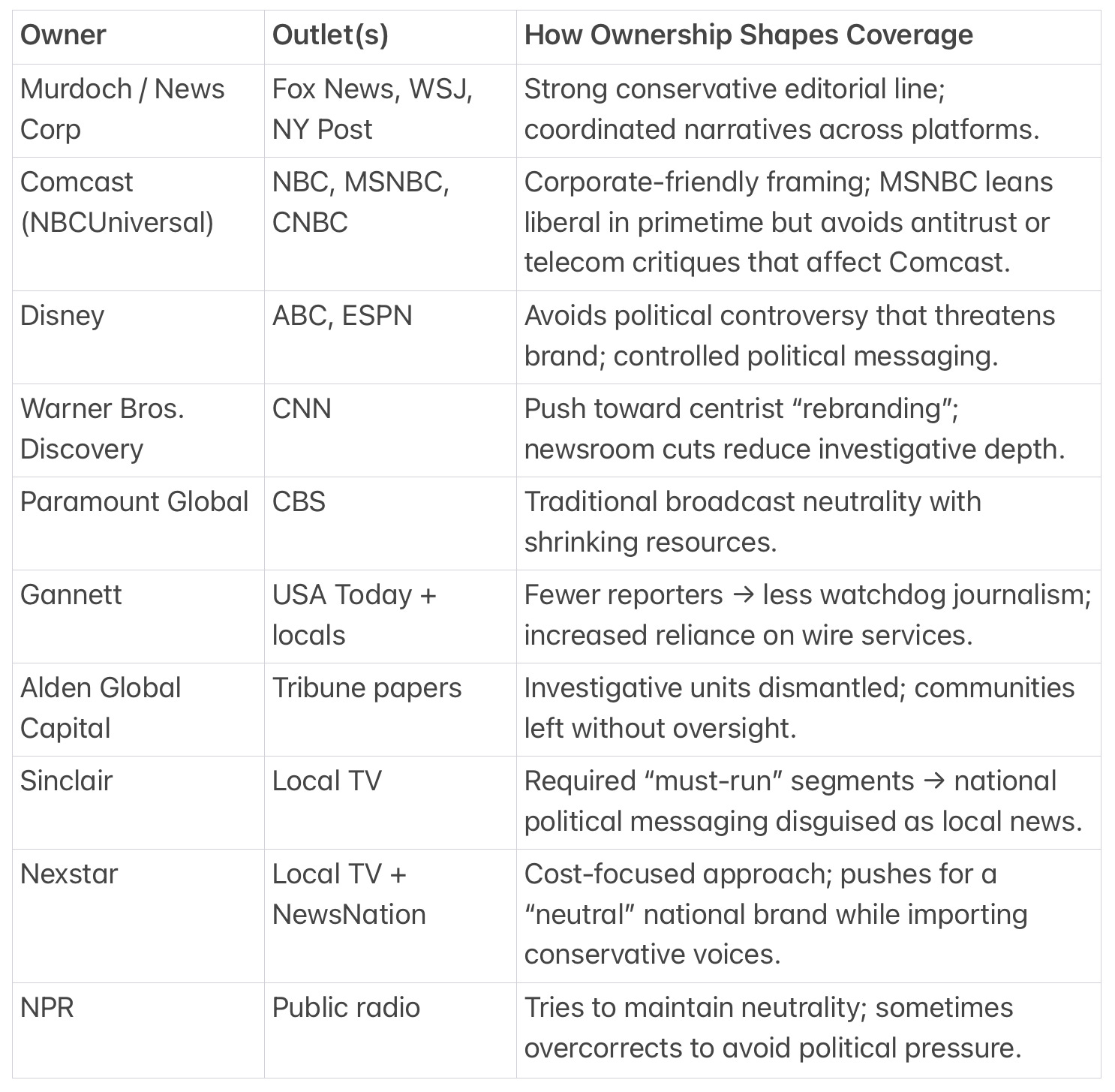
How Ownership Shapes Coverage
9. Why All of This Matters for This Series
Every post so far — tax cuts, healthcare, prisons, education — depends on this truth:
If the public had access to accurate, independent, well-funded local journalism, privatization would have been far harder to sell.
Instead, the media ecosystem:
weakened trust in government
undermined public workers
normalized tax cuts
obscured consequences
amplified misinformation
protected corporate interests
discouraged investigative reporting
rewarded simplicity over truth
It explains how people were persuaded to accept the dismantling of public life.
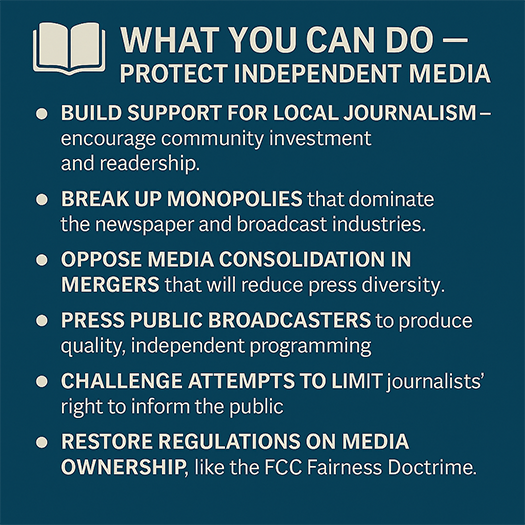
⭐️ What You Can Do
Call your senators and representatives.
Ask them to:
oppose media consolidation and monopolies
block mergers that reduce press diversity
support strong rules on media ownership and transparency
protect public broadcasters from political pressure
Privatization depends on silence. Phone calls still matter.
Then:
Support local journalism whenever possible. Even small outlets matter — they are often the only independent watchdogs left in a community.
Diversify your news diet. Follow reporters, not just brands. Ownership shapes coverage.
Question political messaging disguised as news. If it appeals to fear or resentment, pause and ask why.
Share credible reporting. Your share may reach someone living in a news desert.
Demand transparency from local officials. Independent media and accountable government depend on each other.
References & Further Reading
Media consolidation & local news
Hedge funds & newspapers
Politico — How Hedge Funds Gutted Local News
The Atlantic — Alden Global Capital and the Death of Newspapers
Media ownership & political influence
Fox News & misinformation
Trump and press intimidation
Committee to Protect Journalists — Trump’s attacks on the press
New York Times — Trump’s use of lawsuits and threats against media
I just sent ‘feedback’ to CBS Nightly News this morning. When they came out with a new format featuring John Dickerson and Maurice DuBois as co-anchors, it was refreshing and well done. However, last night was the 2nd night in a row where they’ve had Erica Kirk on ‘live’ (I feel they were forced into this by the now ‘right wing ownership’ of CBS) and I immediately turned if off.. Both John Dickerson and Maurice DuBois resigned and are leaving at the end of the year. (sad)