The Budget is a Mirror
Every fall, Washington stages a crisis. What we fund — and what we starve — tells the truth about who we are.

The Annual Ritual
Step One: The President’s Request (February)
The White House sends Congress a budget proposal. It isn’t binding — more like a wish list that shows priorities. Cut here, add there.
Step Two: The Budget Resolution (Spring)
The House and Senate each pass a resolution setting the big-picture limits (like “defense: X, health: Y”). This creates a framework, but no money is spent yet.
Step Three: Appropriations Bills (Summer)
Congress is supposed to pass 12 separate bills covering different parts of government: defense, veterans, transportation, health, housing, and more. These bills decide how much money actually gets spent, and where. In theory, they should all be passed before October 1.
Step Four: The Deadline (October 1)
That’s the start of the new fiscal year. If appropriations aren’t passed, Congress resorts to a continuing resolution (CR), which keeps last year’s funding levels in place. If even that fails → government shutdown.
Why It Matters
A continuing resolution sounds harmless, but it freezes priorities: the military can’t modernize, agencies can’t start new programs, schools and local governments are left guessing. Shutdowns go further, hurting real people: furloughed workers, delayed paychecks, veterans waiting for services.
Meanwhile, the political theater continues. Each September brings the same showdown — not to solve problems, but to posture.
The Bigger Picture
The last time the U.S. had a balanced budget was 2001. Since then, deficits have piled up year after year. Wars, tax cuts for the wealthy, and crisis spending (2008, COVID-19) all played their part.
Here’s what the budget really looks like today:
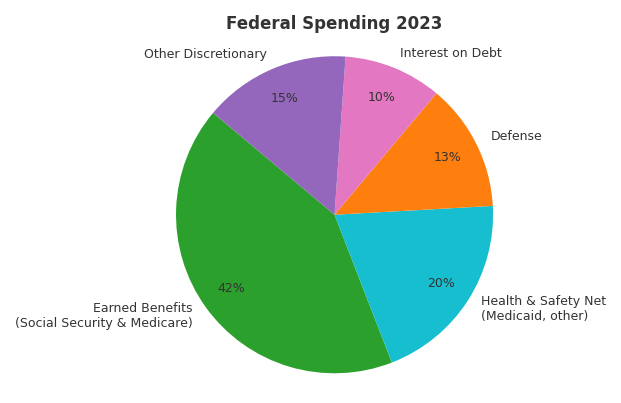
Social Security and Medicare are shown here as “Earned Benefits” — workers paid into them over a lifetime. Cutting them wouldn’t solve the debt problem, but lifting the payroll tax cap or trimming defense excess could.
This chart shows how federal dollars were actually spent in 2023. The largest share — “Earned Benefits” like Social Security and Medicare — represents programs workers paid into throughout their lives, not giveaways.
The next biggest share, health and safety net programs such as Medicaid, helps low-income families and people with disabilities. Defense spending remains the largest discretionary category, while interest on the debt now rivals it in size.
What’s left — other discretionary programs like education, transportation, and scientific research — is a relatively small slice. In other words: the budget reflects national choices, and the debate isn’t about whether we can afford earned benefits, but about what priorities we put first.
Why Balanced Budgets Rarely Happen
The U.S. budget process almost guarantees deficits most years:
Built-in growth: Social Security, Medicare, and Medicaid rise automatically with demographics and health costs.
Defense protection: Congress rarely cuts military spending.
Tax cuts without offsets: Especially for the wealthy, these drain revenue.
Emergency spending: Wars, recessions, and pandemics always mean new borrowing.
Politics of pain: Cutting programs or raising taxes are politically dangerous.
So yes — the system is “designed that way.” Promises are rewarded; hard choices are punished.
What the Debt Really Means
The national debt is the sum of all past deficits — now over $34 trillion. But most of it is money we owe to ourselves.
About 70% is held domestically — U.S. individuals, banks, pension funds, the Social Security trust fund, and the Federal Reserve.
About 30% is held by foreign investors and governments.
That’s why you sometimes hear: “the debt means nothing — it’s just money we owe ourselves.”
Not quite. The debt matters in three ways:
Interest payments are real, and now one of the fastest-growing parts of the budget.
Investor confidence is key — if the U.S. ever looked shaky, interest rates would spike.
Future taxpayers owe interest on today’s borrowing, though they also benefit from what the debt funded (wars, programs, bailouts).
It isn’t meaningless, but it also isn’t a household credit card bill. For a country that prints its own currency, the risk is more about inflation and interest costs than running out of money.
Why the U.S. Isn’t Greece
Sometimes people warn that America will “end up like Greece.” But the comparison doesn’t really hold.
The United States issues debt in its own currency, the dollar. That means it can always create the dollars needed to pay bondholders. The real risks are inflation and rising interest costs — not bankruptcy. That’s why U.S. Treasuries are considered the safest investment in the world.
European countries that joined the euro gave up that safety net. Greece, Italy, Spain, and others borrow in euros, but can’t print euros. Only the European Central Bank controls that. So when investors panicked after 2008, countries like Greece had no choice but to accept painful austerity.
America’s debt isn’t cost-free. But because we borrow in dollars, the U.S. can never “run out” of its own currency the way eurozone countries can.
The General Welfare
The framers of the Constitution didn’t imagine a federal budget fight like the ones we see today. But they did write this: Congress has the power “to provide for the common Defence and general Welfare of the United States.”
That clause has guided two centuries of debate. What counts as “general welfare”? Is it only defense and infrastructure? Or is it also Social Security, Medicare, education, and healthcare?
The Preamble sets the tone: government exists to “promote the general Welfare” — not just for the wealthy, not just for the powerful, but for the people as a whole.
Which means every time we argue about the budget, we’re really arguing about the same thing the founders set down in 1787: how to build a government that protects its people and secures their future.
Closing Reflection
The budget process isn’t a mystery. It’s a broken clock we keep winding up each fall. Until Congress fixes it, the Groundhog Day of shutdown threats will keep replaying — at taxpayer expense.
And behind the annual spectacle lies a deeper truth: budgets are moral documents. They show what we value — and what we choose not to. Taken together, the budget and the name “Defense Department” tell the same story: our priorities are drifting away from true defense. That’s why, in an earlier post, I pushed back on renaming the department.
Key Takeaways
The U.S. hasn’t had a balanced budget since 2001 — and the process itself almost guarantees deficits.
Most of the debt is money we owe ourselves, but rising interest payments are eating a bigger share of the budget.
Social Security and Medicare are earned benefits, not giveaways; lifting the payroll tax cap could secure them without cuts.
Because the U.S. issues debt in its own currency, it cannot “run out of money” like eurozone countries can — but it can make poor choices about what to fund.
References
U.S. Constitution — Preamble & Article I, Section 8
Declaration of Independence — National Archives Transcript
Congressional Budget Office (CBO) — The Budget and Economic Outlook
Center on Budget and Policy Priorities — Introduction to the Federal Budget Process
Wikipedia — United States Budget Process
Good explanation and clarity