✝️ The Cyrus Speaker
How Mike Johnson’s theology sanctifies Trump’s power.

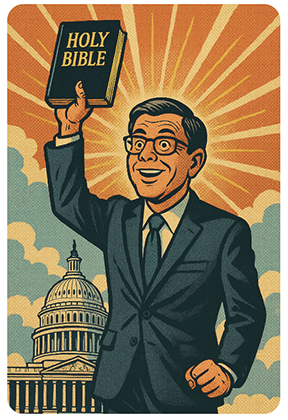
When Mike Johnson rose to the Speakership in October 2023, many Americans had to look him up. Here was a man with only six years in Congress suddenly third in line to the presidency—describing himself as a “Bible-believing Christian,” quoting Scripture on the House floor, and speaking of his elevation as an act of God. But equally striking was how quickly he aligned himself with Donald Trump, a figure whose personal life and governing style appear at odds with Johnson’s publicly proclaimed moral code.
The question is not simply why Johnson supports Trump. It’s how this alignment reflects his worldview, political ambitions, and the evolving relationship between evangelical Christianity and political power in the U.S.
⸻
🧭 1. Theological Framing: Divine Providence Meets Political Power
Johnson’s public language consistently frames events—including political appointments—as instruments of divine will. Upon becoming Speaker, he declared:
“I believe that Scripture, the Bible, is very clear: that God is the one who raises up those in authority… All of us.”
This belief allows him to view Trump’s leadership not through the lens of personal character, but through Providential purpose. In this framing, Trump’s flaws are secondary to the idea that he was “raised up” for a reason—whether to appoint conservative judges, end Roe v. Wade, or defend “religious liberty.”
This mirrors a common evangelical justification for political alliances with morally compromised leaders: God uses flawed vessels to accomplish divine plans. It’s the language of Cyrus, not Christ—Trump as the “unlikely instrument” rather than moral exemplar.
📜 Historical Sidebar: The “Cyrus Model” and the Christian Right
In the Hebrew Bible, Cyrus the Great, a pagan Persian king, is described in the Book of Isaiah as an anointed instrument of God who liberated the Jews from Babylonian exile. Cyrus wasn’t part of God’s people, nor was he morally exemplary — but he was used to achieve divine purposes.
This story has become a powerful political metaphor for many American evangelicals. Beginning in the late 1970s and accelerating under Ronald Reagan, religious leaders like Jerry Falwell and the Moral Majority embraced politicians not necessarily for their personal piety, but for their willingness to advance evangelical priorities: opposition to abortion, defense of “traditional values,” and judicial appointments. Reagan himself was divorced, rarely went to church, and was not an evangelical — but he championed their causes and became a political hero.
Overseas time, this Cyrus framework evolved from pragmatic alliance into theological justification. It allowed evangelical leaders to support politicians who were morally flawed but politically useful — interpreting their rise as part of a divine plan rather than a contradiction of faith.
By the time Donald Trump arrived, the ground was well prepared. Evangelical figures openly invoked the Cyrus analogy to explain why they supported him despite his personal scandals. They pointed to policy victories (e.g., anti-abortion judicial appointments, religious liberty protections) as proof that God was using him for higher ends.
For Mike Johnson, who sees history through a Providential lens, Trump fits squarely into this tradition. His support isn’t a betrayal of his beliefs — it’s their logical extension.
⸻
🧮 2. Strategic Symbiosis: Johnson Gives Legitimacy, Trump Gives Power
Johnson owes part of his rapid ascent to Trump’s endorsement. When House Republicans were deadlocked after McCarthy’s removal, Trump’s blessing helped unify factions around Johnson, who was seen as both ideologically pure and politically unobjectionable.
In turn, Johnson offers Trump what Trump craves: religious legitimacy. Unlike the overtly political figures around Trump, Johnson wears the mantle of faith leader—a bridge between MAGA politics and evangelical institutions. His presence reassures religious conservatives that supporting Trump remains spiritually and morally justifiable.
This is less about shared personality and more about mutual political utility: Johnson helps sanctify Trump’s agenda; Trump helps sustain Johnson’s power.
⸻
⚖️ 3. Judicial and Cultural Goals Outweigh Personal Conduct
Johnson has long been involved with Christian legal advocacy, including the Alliance Defending Freedom, and he celebrates the Trump-appointed Supreme Court majority that overturned Roe v. Wade and reshaped religious liberty law.
For Johnson, these policy victories are the fruit of Trump’s presidency. His support flows less from admiration for Trump’s character than from the judicial and cultural results Trump delivered.
Evangelical political strategy since the late 1970s has often emphasized winning the courts over winning hearts—a long-game view in which cultural and moral influence is secured through legal power, not moral leadership.
⸻
🧍 4. Authoritarian Parenting & Religious Certainty
Early reporting on Johnson’s family life described his strictness with his son—particularly his use of Covenant Eyes, an accountability app that tracks and reports his teenage son’s online activity to Johnson himself. To some, this read as an intensely hierarchical and surveillance-oriented view of morality: sin is prevented through control, not trust. It raises red flags to me.
This attitude mirrors Johnson’s broader political philosophy: strict moral hierarchies, suspicion of secular autonomy, and a belief that authority (whether paternal, governmental, or divine) must shape behavior. Trump’s strongman persona fits comfortably within this worldview—not as a moral exemplar, but as an instrument of order.
For Johnson, Trump’s authoritarian tendencies may not be disqualifying—they may be attractive, if seen as a bulwark against perceived moral and cultural decline.
📌 Sidebar: Covenant Eyes & Control
Covenant Eyes is a Christian accountability app designed to monitor internet activity for “pornography and other temptations.” The monitored user’s activity is logged, analyzed, and emailed to an accountability partner — in Johnson’s case, reportedly his teenage son’s activity is sent to Johnson himself.
This arrangement reveals Johnson’s deeply hierarchical moral philosophy: virtue is not developed through trust and responsibility but enforced through surveillance. For many observers, this raises questions not just about parenting, but about how he understands governance and social control.
If this level of control exists at home, it’s not a stretch to imagine how that worldview might shape his approach to policy, culture, and law. It’s paternalistic, rule-bound, and resistant to pluralism.
⸻
🕸 5. Christian Nationalism & the “Slimy” Factor
Critics have noted that Johnson’s religiosity often blends with Christian nationalist ideas: the belief that America is fundamentally a Christian nation, and that public policy should reflect that identity. This isn’t fringe within his circles; it’s central.
But where some see faith, others see calculated piety—a smooth, lawyerly presentation of an exclusionary vision. Johnson’s background as a constitutional lawyer for evangelical causes gives him rhetorical polish; his actions reveal alignment with Trump’s efforts to reshape government in ways that privilege a narrow religious worldview.
His critics argue that his public piety can mask deeply illiberal goals: weakening church–state separation, rolling back civil rights protections, and concentrating power in the executive and judiciary to advance a particular brand of Christianity. In that light, his support for Trump isn’t surprising. It’s a partnership of ends, not of ethics.
⸻
🟡 Conclusion: A Devout Strategist, Not a Moral Outlier
Mike Johnson’s support for Donald Trump makes sense when viewed through his theological lens, strategic calculations, and cultural priorities. He does not see Trump as a role model. He sees him as an instrument—a flawed but powerful vessel for a divine or historical mission as Johnson understands it.
This doesn’t absolve the contradictions; it illuminates them. Johnson’s strict moral governance at home and his embrace of Trump in public life reveal a consistent logic: authority and outcomes trump personal virtue.
It’s a vision that places divine mandate above democratic pluralism, and moral order above individual liberty—a vision increasingly influential in modern American politics.
⸻
📚 Epilogue: When Moral Platforms Crack
Jerry Falwell helped launch the modern Christian Right by fusing religion and politics into a single moral crusade. But as history showed, Falwell didn’t fall well—and his movement has repeatedly produced leaders who rise on moral authority only to fall under its weight.
Mike Johnson may project quiet conviction rather than Falwell’s theatrical certainty, but the structure is similar: moral absolutism, personal control, and political power bound tightly together. History suggests that such towers often look strongest right before they start to sway.
For a man who so often quotes Scripture, Johnson’s appearances on Sunday news programs raise a biblical question of their own: ‘Thou shalt not bear false witness.’
⸻
📚 References & Further Reading
• AP News: Who is new House Speaker Mike Johnson? — background on his upbringing, faith, legal work, and rise.
• Time: Speaker Mike Johnson and the Christian Nationalist Movement — analysis of his ideological alignment.
• Brookings Institution: Who is Mike Johnson? — detailed policy and leadership background.
• ProPublica / Religion News Service: have both run shorter pieces linking him to Christian nationalist legal groups and networks like Alliance Defending Freedom.
• Covenant Eyes: company site — useful for confirming the exact function of the surveillance app.