The Detention Pipeline
How warehouses, federal funding, and private contracts transformed detention into permanent infrastructure

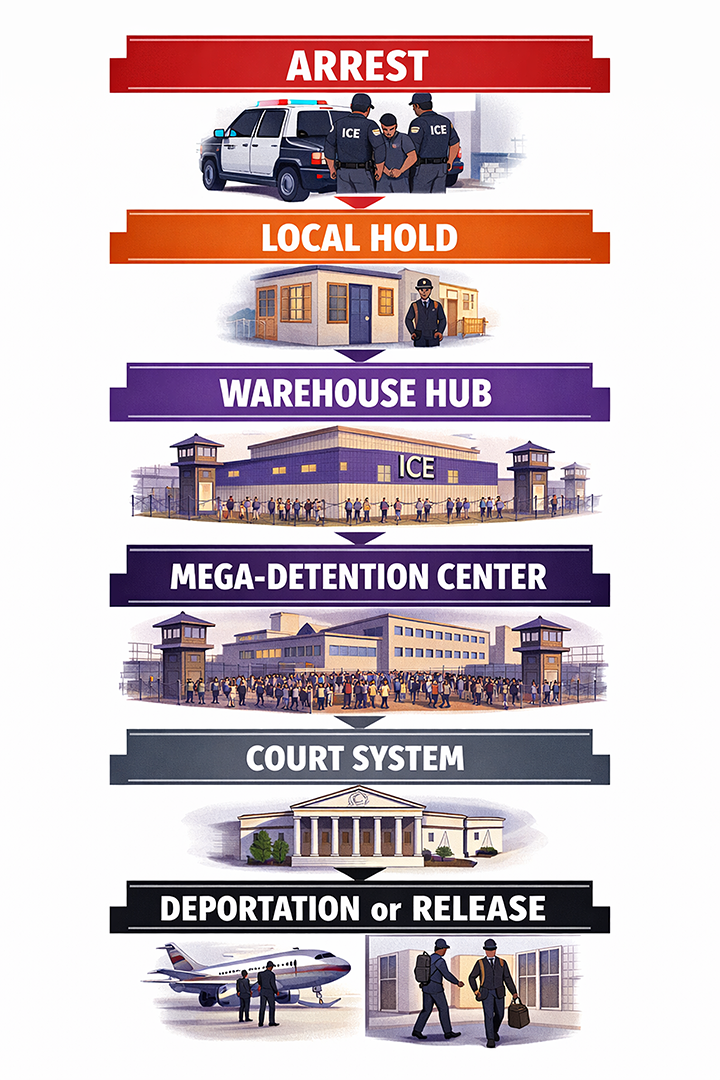
1. Warehouse-to-detention conversion is the core strategy
The biggest shift is ICE converting industrial warehouses into detention centers, some on a scale never seen before.
ICE is planning to convert about 23 large warehouses into detention sites.
These facilities could hold 500 to 9,500 people each, making some of them among the largest detention centers in U.S. history.
The plan includes:
Smaller “feeder” sites holding 500–1,500 people
Larger regional “mega-centers” holding 5,000–10,000 people
ICE documents show tens of billions of dollars being spent to convert warehouse spaces into detention centers.
These are not traditional prisons—they are often repurposed industrial buildings.
2. The total detention system is being dramatically expanded
This expansion is structural, not temporary.
Congress approved about $45 billion in detention funding, enough to hold over 100,000 people at once.
ICE detention capacity is planned to reach 107,000+ beds, roughly doubling the system.
ICE already detains about 70,000 people daily across roughly 225 facilities.
More than 125 facilities may be opened or expanded nationwide.
This would create the largest immigration detention system in U.S. history.
3. Specific new or proposed facilities include
These examples show how widespread the expansion is:
Texas
San Antonio: ICE purchased a building to convert into a 1,500-bed detention center.
Georgia
Social Circle facility planned to hold up to 10,000 detainees.
Michigan (possible)
ICE has considered sites in the Detroit area; plans could add thousands of beds.
Indiana
New ICE administrative and potential detention sites being explored.
Military sites
Example: Fort Bliss facility with capacity up to 10,000 detainees.
4. Private prison companies are heavily involved
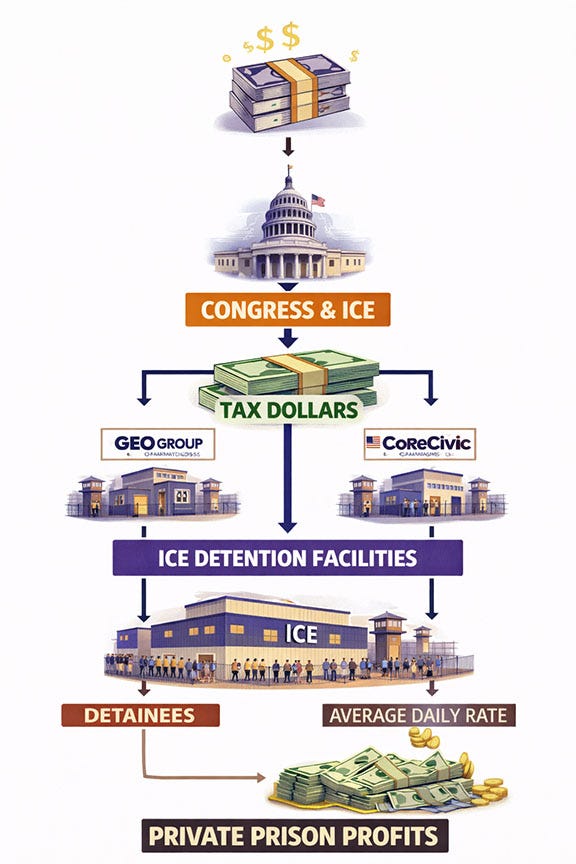
Two companies dominate:
GEO Group
CoreCivic
They are reopening prisons and expanding capacity, reporting record revenues from ICE contracts.
Most ICE detainees are already held in private facilities.
5. ICE is also expanding offices and infrastructure nationwide
This includes enforcement hubs, not just prisons.
ICE has leased or opened 150+ new offices across nearly every state.
These facilities support enforcement, detention processing, and deportation operations.
6. Communities across the country are pushing back
Cities, states, and citizens are resisting many of these facilities.
Some warehouse deals have been blocked by local opposition.
Residents and local officials have protested or challenged detention plans in multiple states.
7. Structural purpose: create a nationwide detention pipeline
The system is designed as a chain:
Arrest → short-term warehouse facility → regional mega-center → deportation or transfer
This structure allows ICE to detain far more people than before.
The expansion of ICE detention is not occurring randomly. It is being built as infrastructure.
Warehouses are being converted into intake hubs.
Mega-facilities are being expanded or reopened.
Private prison companies are receiving long-term federal contracts.
Congress has authorized billions in funding to increase detention capacity.
This creates a system designed not simply to deport people, but to detain large numbers of people continuously.
Detention itself has become its own operational layer — separate from deportation.
The key structural change is capacity. Before, detention was limited by the number of existing prison beds. Now, warehouse conversion removes that limit.
This allows the system to scale. Arrest capacity feeds detention capacity.
Detention capacity sustains the system regardless of how fast courts or deportations occur.
The result is a permanent detention infrastructure. Once built, it does not depend on emergencies.
It becomes part of the landscape.
What can be done
Structural systems are built through law, funding, and public acceptance. They can also be changed through those same mechanisms.
1. Public awareness
Most structural systems depend on remaining invisible.
Understanding how the system works — and helping others understand — removes that invisibility.
Infrastructure is harder to expand quietly when it is widely seen.
2. Local government authority
Many detention facilities require:
local zoning approval
utility access
infrastructure support
contracts with local governments
Local officials and residents can influence whether facilities are approved, expanded, or blocked.
Recent examples show that community opposition has successfully delayed or stopped some proposed sites.
3. Legal challenges
Courts remain one of the few mechanisms capable of slowing or limiting structural expansion.
Legal challenges have historically affected:
detention conditions
facility approvals
enforcement practices
administrative authority
The legal process is slow, but it remains an active constraint.
4. Congressional authority
Congress controls:
funding levels
detention capacity authorization
oversight authority
Changes in law or funding priorities can alter the scale of detention infrastructure.
This is ultimately where the structure is authorized.
5. Documentation
Documentation matters.
Journalists, researchers, and citizens who record what is being built create a public record.
That record becomes part of future accountability.
Structural systems depend on both physical infrastructure and public acceptance.
Both can change over time.
References
Government and policy analysis
American Immigration Council — Immigration Detention in the United States
U.S. Immigration and Customs Enforcement (ICE) — Detention statistics and facility information
Reporting on warehouse conversions and expansion
mlive.com — Owner of Michigan ICE detention center reported $254M profit last year
WIRED — “ICE Is Expanding Across the U.S. at Breakneck Speed”
Bloomberg — “U.S. Spending Hundreds of Millions on Warehouse Detention Centers”
The Guardian — Reporting on warehouse conversion and detention expansion
Private prison companies
GEO Group — Investor reports and ICE contracts
CoreCivic — ICE detention contracts and financial reports
Brennan Center for Justice — Private prisons and immigration detention analysis
Court system and detention structure
Transactional Records Access Clearinghouse (TRAC) — Immigration court backlog data
WTF. ICE detention centers sound like concentration camps (eg early 1930s Germany; WW2-era Japanese camps in US) that detained large numbers of civilians without trial, based on their group identity. Also, I’ve read about the inhumane conditions and seeming lack of proper oversight in these modern-day detention centers.