The Permission Structure
How the Roberts Court made election interference safer — and why the midterms are the test

The most dangerous change in American democracy did not come with tanks in the streets or ballots burned in public squares.
It came with legal language.
In 2024, the Roberts Court rewrote the rules of presidential accountability. It did not declare a president king. It did something more subtle — and far more useful to someone willing to abuse power.
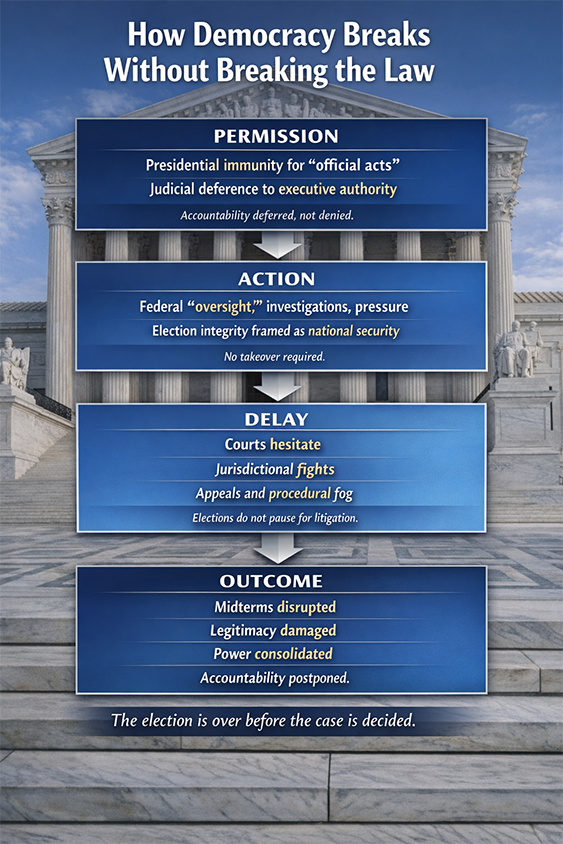
It removed the penalty for trying.
What followed was not chaos. It was permission.
The doctrine (plain English)
The Court ruled that a president is presumptively immune from criminal prosecution for “official acts.”
That sounds technical. It isn’t.
It means:
Use federal agencies → probably immune
Frame actions as national security, law enforcement, or election integrity → probably immune
Test the boundary → safe enough to attempt
Accountability was not eliminated. It was delayed. And delay is decisive in elections.
What midterms look like under this doctrine
This is not hypothetical. This is how it works in practice.
1. Federal pressure without formal takeover
No need to “run” state elections.
Instead:
Federal “reviews”
Federal “investigations”
Federal “oversight”
Federal demands for records, ballots, machines, or personnel
All framed as official executive functions.
Courts hesitate to interfere with “ongoing executive action,” especially close to an election.
2. Contradiction becomes strategy
Trump’s statements are not confusion. They are flexibility.
“States run elections” → when states comply
“Republicans should run elections in Democratic states” → when they don’t
“Federal government must step in” → when pressure is needed
The doctrine doesn’t require consistency.
It rewards leverage.
3. Delay becomes the weapon
Even if courts eventually intervene:
Jurisdiction must be argued
Immunity must be parsed
Appeals must be heard
Midterms happen once.
The damage happens before the ruling.
4. Legitimacy erosion, not ballot theft
This isn’t about stuffing ballot boxes.
It’s about:
Casting doubt
Freezing processes
Intimidating administrators
Creating parallel “official” narratives
You don’t need to overturn every race.
You just need to poison enough of them.
Why this fits Project 2025
Project 2025 assumes:
A president willing to push boundaries
Courts unwilling to stop him quickly
Bureaucracies that can be bent, purged, or redirected
Legal justifications for extraordinary control
The Roberts Court made those assumptions rational.
This is not a coup plan.
It’s an administrative capture plan.
The warning Lisa Graves is issuing
Lisa Graves is not predicting a single illegal act.
She is warning about system design.
A system where:
Executive power expands first
Accountability arrives later — if at all
And elections occur in the gap
That gap is where democracies fail.
The paragraph that says it plainly
Yes — people should be scared.
Not because a dictator has been declared, but because the legal cost of abusing power has been lowered. When a president can interfere with elections, investigations, or certification as an “official act,” and courts cannot stop that interference in real time, elections become conditional. They exist at the pleasure of executive restraint — not constitutional guarantee. That is not alarmism. That is mechanics.
What Must Be Done
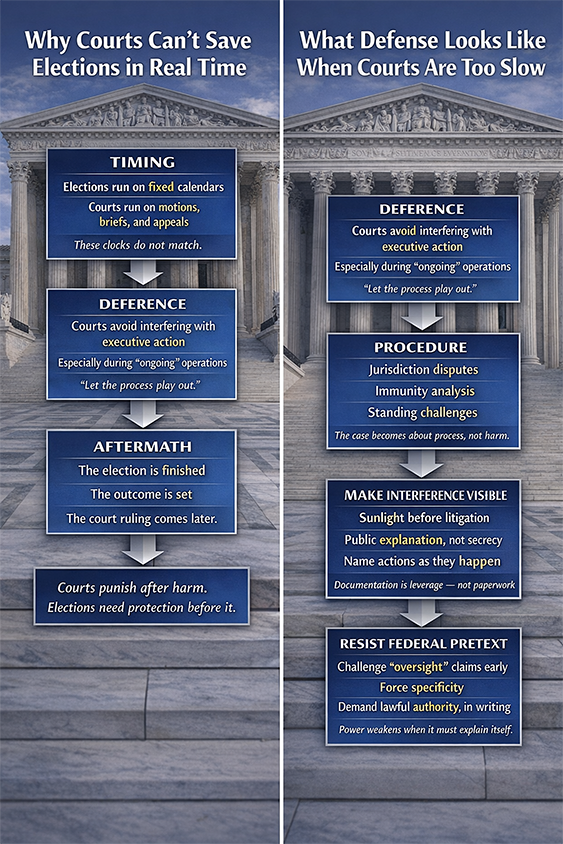
When courts are too slow, defense has to move earlier and faster than interference.
That means two things in practice:
Visibility before litigation
Interference must be named as it happens, not months later in court rulings. Written directives, timelines, and public explanations matter because secrecy is what allows delay to do its damage.
Pressure before elections, not after.
The most effective safeguards are pre-election: clear statutory limits, early injunctions, and demands for specific legal authority when federal “oversight” is claimed. Once an election is over, legitimacy damage cannot be fully repaired.
Courts still matter — but they are no longer sufficient on their own.
References & Further Reading
Election law, courts, and executive power
Supreme Court of the United States (2024). Trump v. United States — presidential immunity decision
Justice Sonia Sotomayor, dissent — warning on unchecked executive power
Analysis of the Roberts Court and executive authority expansion
Federal pressure on election systems
Reporting on FBI seizure of election materials in Fulton County, Georgia
DOJ efforts to obtain voter rolls from Democratic-led states
Lisa Graves — interviews and analysis on court capture and accountability
Brennan Center for Justice — election administration, federalism, and safeguards