The Privatization Push
How deregulation paved the way for private profit — and the network behind the Court is cashing in.

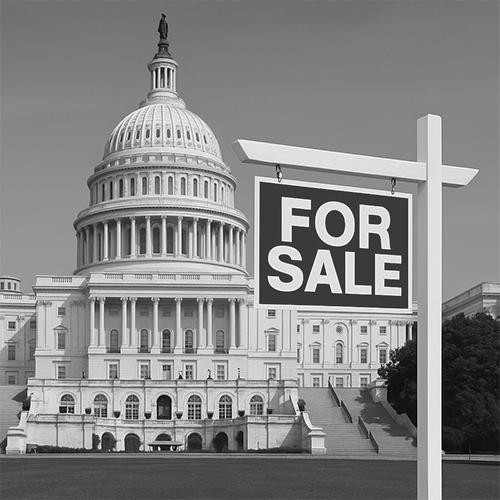
1. The Long Game Pays Off
Deregulation wasn’t an accident or a phase — it was a strategy.
Each rollback of oversight, each narrowing of federal authority, cleared the path for private actors to step in.
The same network that reshaped the Supreme Court — through the Federalist Society, Heritage, ALEC, and Leonard Leo’s web of donor funds — also built the political infrastructure to profit from what it dismantled.
Their message: Government is the problem.
Their goal: Turn every public function into a private market.
2. From Deregulation to Privatization
Once guardrails were gone, investment firms flooded into sectors that had been designed for public service:
Banking: After Glass-Steagall’s repeal, speculation replaced stability; community banks vanished; private equity filled the vacuum.
Healthcare: Hospital mergers, nursing-home buyouts, and for-profit hospice chains turned care into yield.
Justice: Private prisons, probation services, and immigrant-detention contracts .
Education & Infrastructure: Charter management firms and toll-road operators sold “efficiency” while skimming profit from public assets.
Each step looked different on the surface — but the script was the same:
Dismantle public power. Then sell off what’s left.
3. The Network Behind It
The money trail loops back to the same donors who built the Court’s majority.
Tax-exempt “social welfare” groups feed into dark-money funds like the Concord Fund, Marble Freedom Trust, and Donors Trust.
Their lawyers draft the lawsuits; their think tanks supply the talking points; their justices write the opinions.
What began as a legal movement has become an investment portfolio — one where ideology and profit are indistinguishable.
4. What It Looks Like on the Ground
For ordinary people, privatization isn’t an abstract policy.
It’s a $300 hospital bill for a five-minute test.
It’s a “public-private partnership” that replaces water pipes — and triples the rate.
It’s a prison town whose budget depends on keeping cells full.
They call it efficiency.
We live with the consequences.
What You Can Do
🪧 Ask where your money goes.
Check whether your local hospital, utility, or nursing home is privately owned — or owned by a private-equity fund.
📬 Support transparency laws.
Back state and federal efforts to require ownership disclosure for hospitals, prisons, and critical infrastructure.
💡 Share knowledge.
Send this post to someone who still believes privatization means efficiency.
It’s not smaller government — it’s government for rent.
References
Lisa Graves, Without Precedent: How the Supreme Court’s Conservative Majority Is Remaking America
Donald Cohen & Allen Mikaelian, The Privatization of Everything
CI&D “Death Spiral: Private Equity Ownership Of Health Care”
American Prospect: “ALEX’s Corporate Playbook for Privatization”
In the public interest: The Privatizer in Chief
It does seem overwhelming …..I can’t imagine any of the hospitals in my area being privately owned……all are part of a ‘group’ - “Honor Health”, “Banner Health”….etc etc.