The Quiet Architecture Behind Project 2025
Why turmoil at the Heritage Foundation doesn’t dismantle the project itself

When news broke that the Heritage Foundation was fracturing internally, many people felt a wave of relief. For months, Heritage had become shorthand for Project 2025 itself — so it was natural to assume that trouble at Heritage meant trouble for the project as a whole.
That relief isn’t misplaced. Institutional turmoil matters. But it isn’t the whole story.
Project 2025 was designed to function as an ecosystem, not a single institution. Understanding that structure helps explain why some parts weaken under public scrutiny — and why others continue quietly, largely unseen.
The Misunderstanding
Project 2025 is often treated as a single Heritage Foundation project. That framing made Heritage’s recent turmoil feel like a decisive blow.
Why Heritage’s Troubles Don’t End Project 2025
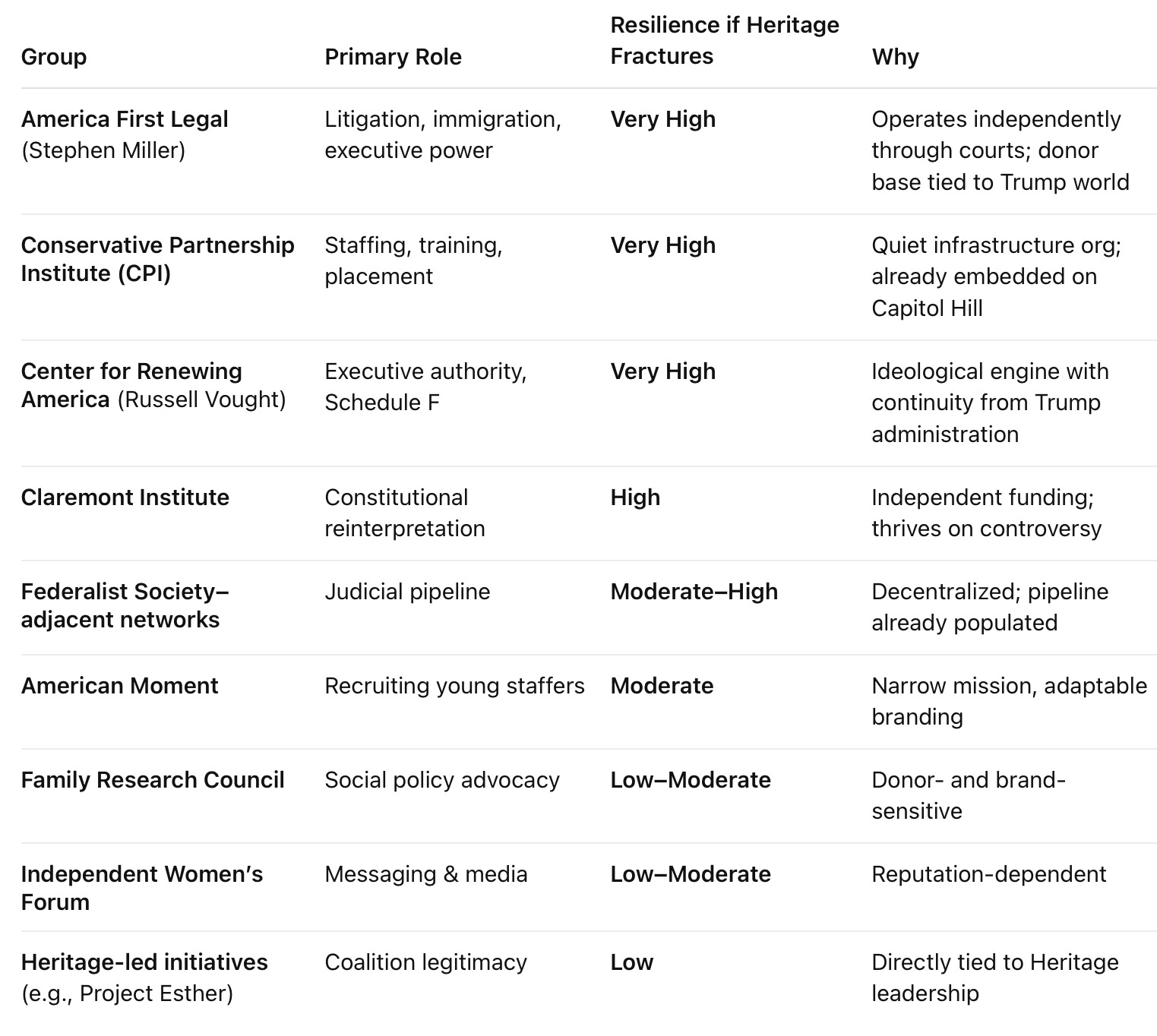
Project 2025 is often associated with the Heritage Foundation, but Heritage primarily served as a public-facing coordinator. The project’s operational core lies elsewhere — in judicial vetting pipelines, legal doctrine development, and targeted litigation.
Organizations such as the Federalist Society, America First Legal, and staffing groups linked to Schedule F continue to shape courts and agencies regardless of Heritage’s institutional health. This structure explains why reputational damage weakens legitimacy, but does not dismantle the machinery of governance change.
The Reality
Project 2025 functions as a distributed ecosystem, not a single institution.
⸻
Four Operational Layers
Public Face & Coordination
Branding, convening, legitimacy
⸻
Ideas & Doctrine
Executive power theory, constitutional reinterpretation
⸻
Courts & Lawfare
Litigation, judicial pipelines, precedent-building
⸻
Staffing & Agency Control
Training, vetting, placement, Schedule F
Key Insight
Heritage’s role is visibility and legitimacy.
The most durable power sits in courts, staffing pipelines, and executive authority planning.
Bottom Line
Brand damage weakens Project 2025’s public standing — but its operational core remains largely intact.
📌 Why this matters:
Institutions that shape law and personnel can remain effective even when public-facing organizations fracture.
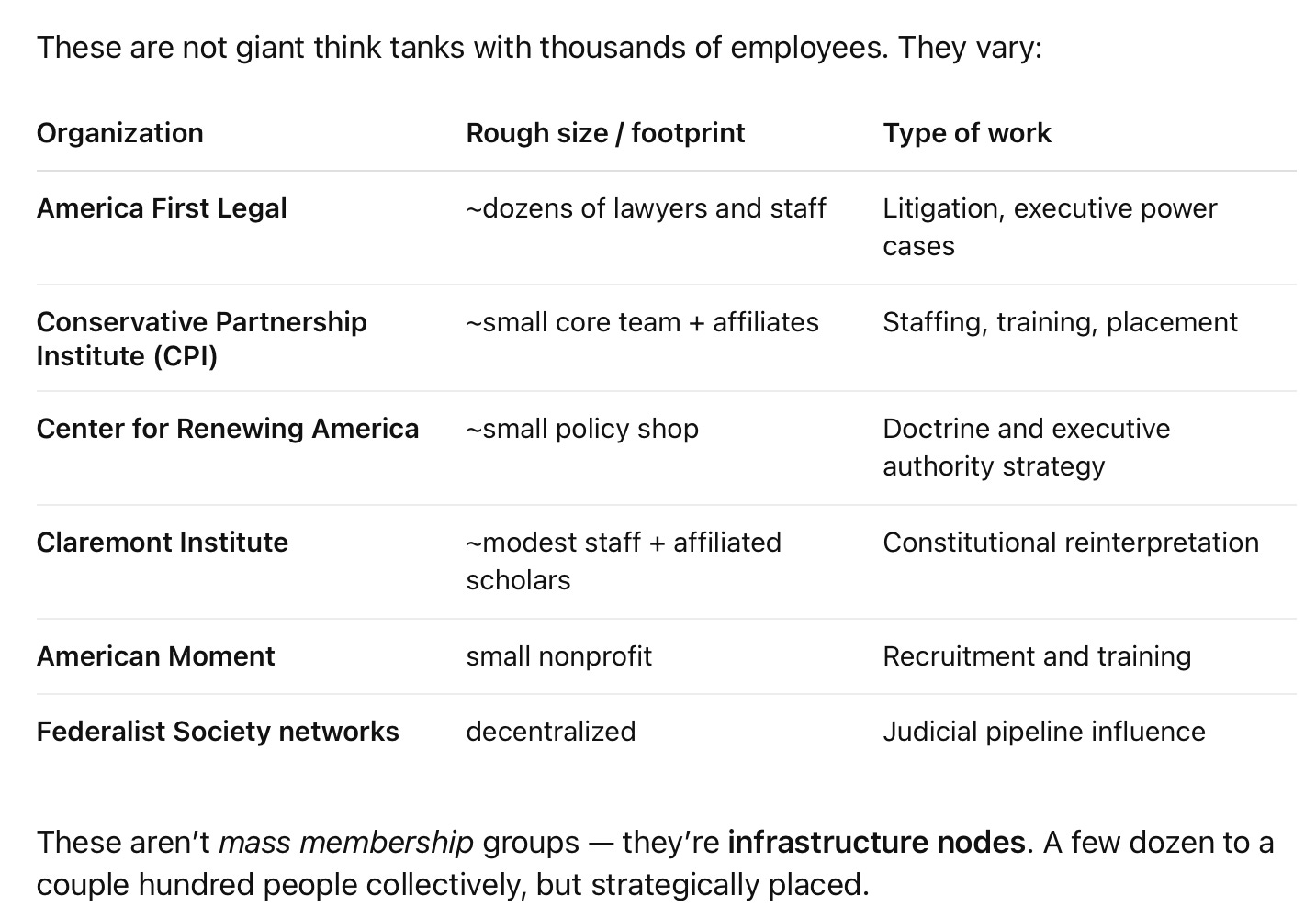
Why Size Doesn’t Equal Power
Many of the organizations driving Project 2025 are small — sometimes only dozens of people. That doesn’t make them weak.
Power in modern governance comes from position, not headcount.
A small legal group can shape national policy by filing the right lawsuit. A small staffing organization can control an agency by placing the right people. A small think tank can influence decades of law by supplying arguments courts adopt.
Large institutions attract attention.
Small, specialized institutions change outcomes.
That’s why some of the most influential players in Project 2025 are also the least visible.
Key Insight
Heritage’s role is visibility and legitimacy.
The most durable power sits in courts, staffing pipelines, and executive authority planning.
⸻
In the next post, I’ll turn to the role of the courts. Understanding the organizations behind Project 2025 explains who is positioned to act; understanding recent Supreme Court decisions explains how that action became possible. Over the past decade, the Court has reshaped administrative law and expanded executive authority in ways that make staffing pipelines and agency control far more consequential than they once were. That legal groundwork is the missing piece in understanding why projects like this can move forward quietly, even amid institutional turmoil.
Thank you for pointing this out. I go to the P-tracker weekly to see how and what has been implemented and the destruction that this project is and has been doing from Education, Energy, Interior to Health as well as so much more.
This project is at 50% completed as in implementation and moving forward. This in 341 days since he has been in office and knowing absolutely nothing about this project. Never believe a serial liar.
As of December 26, 2025, Donald Trump has approximately 1,121 days remaining in his second term. What do you think all the other organizations other than the Heritage Foundation will be bringing to the table that will be affected? It’s mind-boggling that there isn’t a counter argument or project yet written that I may not be aware of but it should be already have gotten off the floor.
https://www.project2025.observer/en