The Quiet Weapon
💼 How the Supreme Court Protects Presidential Power in the Shadows

Some understand the perks of power—the profits, the influence, and how the presidency can become a business model.
Now we look at its protection.
Sometimes it’s loud: legal delays, loyal judges, and primetime press conferences.
But the quiet weapon might be the most dangerous of all:
The Supreme Court’s shadow docket.
Now we examine its shield.
Quiet. Hidden. But deeply dangerous.
This is the world of the Supreme Court’s shadow docket.
⚖️ What Is the Shadow Docket?
This is where rulings happen without full briefing, oral argument, or signed opinions—often late at night:
Emergency applications (like stays or injunctions)
Executive-friendly interventions without public reasoning
Since 2017, the use of the shadow docket has surged—with just 44 cases in one year exploding to 113 the next .
These rulings carry real weight. They change laws, policies, and lives—all publicly invisible.
🚨 The Presidential Advantage
During Trump’s administration, his team turned the shadow docket into a strategic tool:
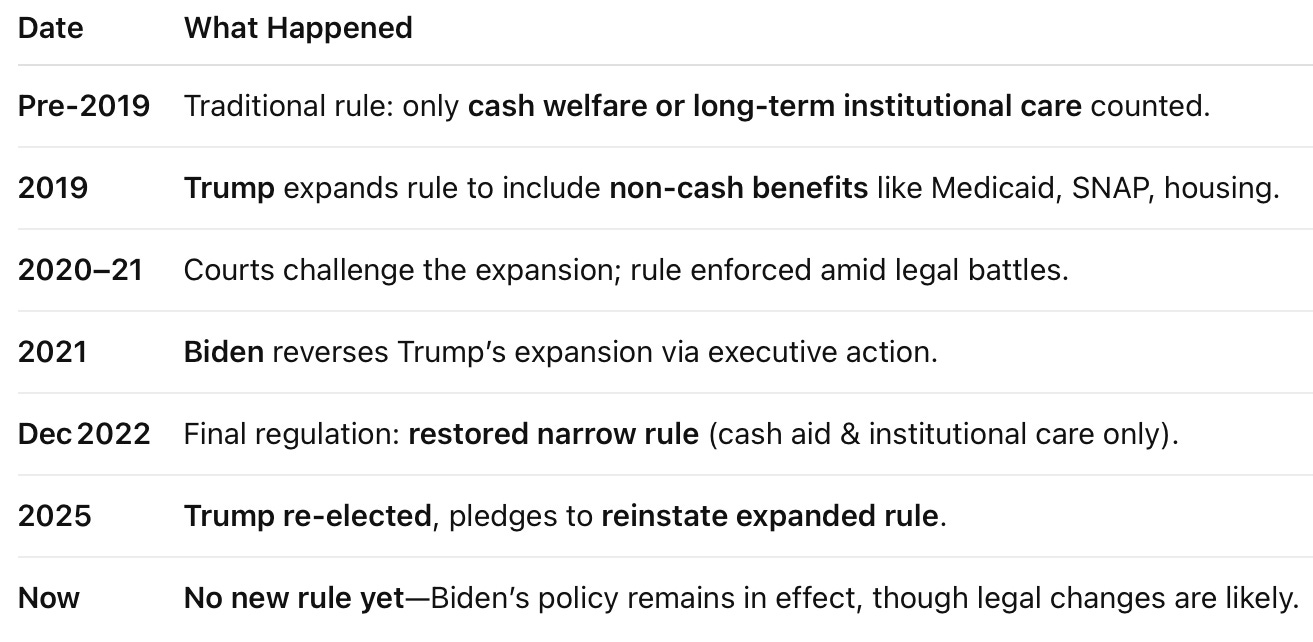
Letting policies like the “public charge” rule stand*
Pausing subpoenas for his records
Greenlighting border wall funding
All done quietly—with no court reasoning, no transparency, and no accountability.
Note: *“Public charge” is a ground of inadmissibility. Grounds of inadmissibility are reasons that a person could be denied a green card, visa, or admission into the United States. In deciding whether to grant some applicants a green card or a visa, an immigration officer must decide whether that person is likely to become dependent on certain government benefits in the future, which would make them a “public charge.” It is not a test that applies to everyone, not even to all those applying for green cards.
Status of “Public Charge”
🚨 Emergency Orders, No Explanation
The shadow docket refers to Supreme Court rulings made without full briefings or public arguments—often on an emergency basis.
There’s no debate. No reasoning.
And often… no one even knows it happened until it’s too late.
This is how rights are quietly eroded. It’s how border walls are funded without Congress. How Muslim bans go into effect. How executions get greenlit hours before they happen.
Justice Elena Kagan once warned:
“The Court’s emergency rulings have become more and more unreasoned, inconsistent, and impossible to defend.”
Justice Sonia Sotomayor has echoed the concern:
“This Court’s shadow docket decisions are shaping the law—and undermining its legitimacy.”
And now, Justice Ketanji Brown Jackson is joining them with force.
🧨 Jackson’s Warning Shot
In her recent dissent on Garland v. Cargill—a case about bump stocks—Justice Jackson didn’t just disagree with the ruling. She warned that the Court had opened the door to unchecked executive power.
“This case marks yet another example of how the Court substitutes its own judgment for that of Congress and the Executive Branch—while ignoring basic principles of administrative law.”
The decision went far beyond bump stocks. It signaled that agencies like the EPA, FDA, and others may soon be limited in what they can do—unless Congress spells it out explicitly.
In today’s gridlocked Congress, that’s a setup for failure.
🧾 Amicus Briefs: Friends with Influence
When the Court hears a case, it often receives amicus briefs—“friend of the court” filings meant to offer perspective or expertise.
But many of these come from organizations backed by dark money, especially in high-profile cases.
Senator Sheldon Whitehouse has warned that these briefs are being used to orchestrate legal outcomes—giving the illusion of broad support for one side, when in fact, it’s funded by just a few powerful players.
👩🏽⚖️ The Gender Divide on the Bench
When it comes to questioning the shadow docket and unchecked executive power, a clear pattern has emerged:
The three women on the Court—Justices Jackson, Sotomayor, and Kagan—are the most consistent voices of dissent.
Occasionally, Justice Barrett joins them. But more often, it’s a 6–3 split—not just ideological, but gendered.
This silent divide adds another layer to the Court’s imbalance—one not just of power, but of perspective.
🧊 Roberts’ Quiet Power
Chief Justice John Roberts doesn’t often raise his voice. But he rarely intervenes either.
And in the shadow docket, silence can be a strategy.
Critics say he’s trying to preserve the Court’s image while letting the majority carry out an aggressive legal agenda.
Others say he’s simply unwilling—or unable—to control the extremes on his bench.
What’s clear:
A president with enough allies in robes doesn’t need to break the law loudly.
He just needs a Court that looks the other way.
🔍 References and Further Reading
The Scheme 29: Fake Facts and “Knight‑Errantry” at the Supreme Court
Whitehouse explains how the Court’s decisions rest on orchestrated falsehoods, not facts.
🔗 https://www.whitehouse.senate.gov/news/speeches/the-scheme-29-fake-facts-and-knight-errantry-at-the-supreme-courtSenate Judiciary Subcommittee Hearing — “What’s Wrong with the Supreme Court: The Big-Money Assault on Our Judiciary”
Detailed testimony about dark money networks shaping the Court.
🔗 https://www.judiciary.senate.gov/committee-activity/hearings/whats-wrong-with-the-supreme-court-the-big-money-assault-on-our-judiciaryKnights‑Errant: The Roberts Court and Erroneous Fact‑Finding (PDF)
Whitehouse’s full-length paper detailing how the Court invents its own facts.
🔗 https://www.whitehouse.senate.gov/wp-content/uploads/2024/02/Whitehouse-Knights-Errant-Fact-Finding-FINAL.pdfSCOTUSblog: “Senate Judiciary Holds Hearing on Dark Money and the Supreme Court”
Neutral summary of Whitehouse’s major hearing on judicial capture.
🔗 https://www.scotusblog.com/2021/03/senate-judiciary-holds-hearing-on-dark-money-and-supreme-courtNews Release: “Captured Courts” Report
Reveals how the judicial nomination pipeline was built to serve donor interests.
🔗 https://www.whitehouse.senate.gov/news/release/senators-unveil-new-captured-courts-report-exposing-the-judicial-crisis-networks-central-role-in-a-scheme-to-capture-and-control-the-supreme-court