The Supreme Court Ethics Problem — Revisited
What happens when the Court meant to restrain power instead enables it?
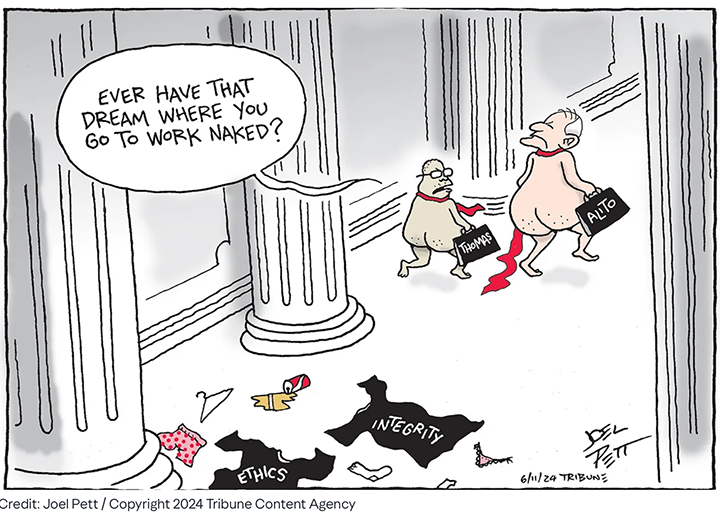
The Supreme Court is supposed to be a check on presidential abuse of power.
In recent years, it has too often failed to play that role.
We’ve seen what unchecked executive power looks like:
Executive orders used as political weapons
Emergency powers stretched far beyond their original purpose
Legal challenges fast-tracked by a Supreme Court increasingly aligned with one political movement
Now add this:
Two justices — Clarence Thomas and Samuel Alito — implicated in serious ethics scandals involving undisclosed gifts, luxury travel, and political entanglements
A Chief Justice who authored Citizens United, embedding the idea that money is speech into constitutional law
No binding, enforceable code of ethics for Supreme Court justices
This is not just a legal failure.
It is a cultural failure — one that has allowed a president like Donald Trump to benefit from the Court rather than be constrained by it.
🧩 The Scheme Behind the Bench
Federalist Society & Leonard Leo
This did not happen by accident.
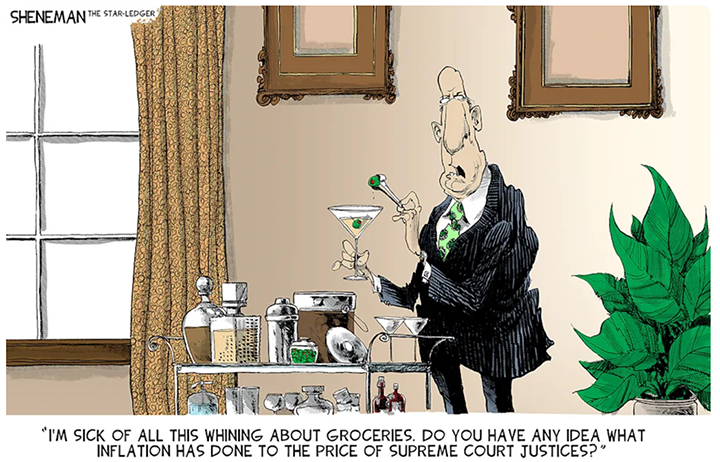
For years, Senator Sheldon Whitehouse has documented what he calls “The Scheme” — a coordinated, well-funded effort to capture the federal judiciary.
At the center of that effort:
The Federalist Society, which vets and pipelines judicial nominees based on ideological loyalty
Leonard Leo, who helped design and finance a parallel influence network operating outside public accountability
This network:
Handpicks judges long before voters ever hear their names
Floods the Supreme Court with coordinated amicus briefs, often from groups funded by the same donors
Creates the appearance of legal consensus while masking a narrow ideological agenda
This is not persuasion. It is structural capture.
By the time cases reach the Court, outcomes are often pre-shaped — not by neutral law, but by years of strategic grooming, funding, and pressure applied behind the scenes.
🧱 What Congress Tried to Do — and Why It Matters
In 2022, lawmakers introduced the Twenty-First Century Courts Act, an attempt to impose basic accountability on the most powerful court in the country.
It would have:
Created a binding Code of Conduct for Supreme Court justices
Required disclosure of gifts, travel, and hospitality
Strengthened recusal standards
Increased transparency around amicus briefs and outside influence
Expanded public access to court proceedings
The bill never made it out of committee.
When that Congress ended, it expired.
That failure did not end the problem — it exposed it. In the current Congress, similar reforms were reintroduced as the Supreme Court Ethics, Recusal, and Transparency Act (SCERT).
🗣️ Why Introduce a Bill That Probably Won’t Pass?
When Senator Whitehouse reintroduced ethics reform, he was blunt: it will be difficult to pass given the Republican congress, but it’s important to keep the issue in the public eye.
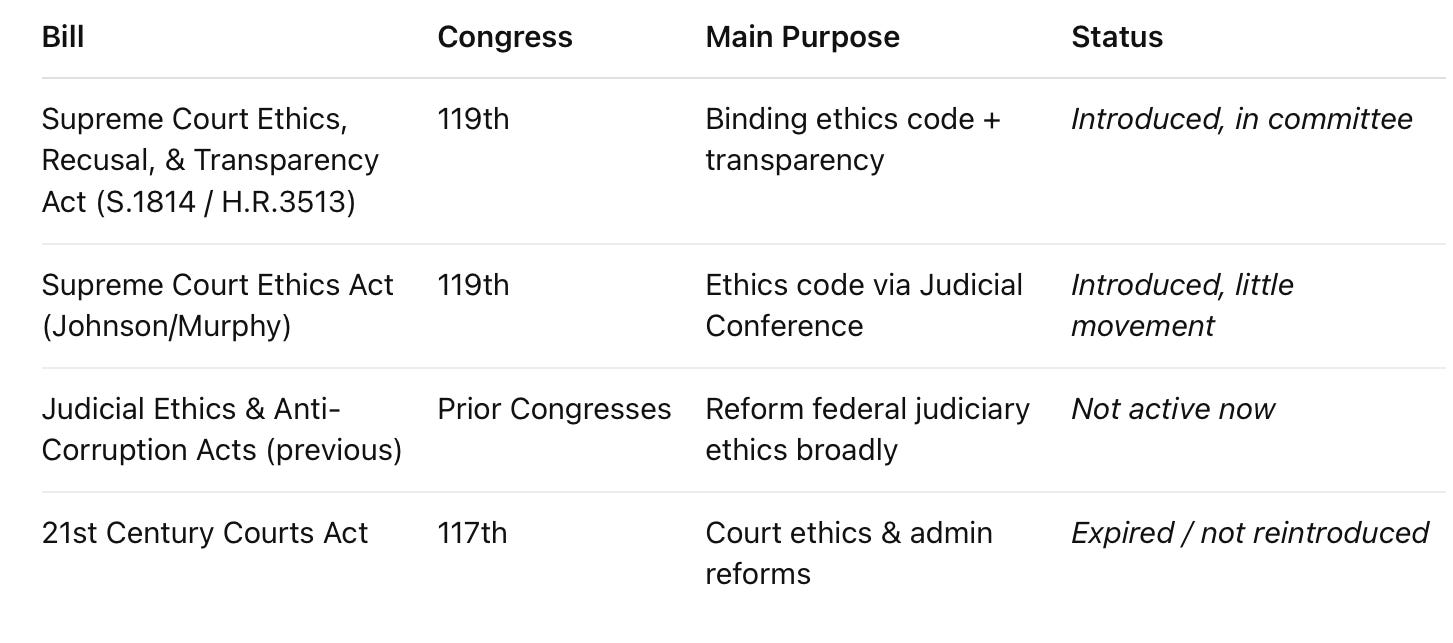
That matters. These bills:
Create a public record of known failures
Establish that Congress recognizes the legitimacy problem
Make it harder to pretend that self-policing is sufficient
Today’s “messaging bill” becomes tomorrow’s unavoidable baseline.
That’s how institutional reform actually happens.
⚖️ The Supreme Court’s Ethics Code — and Why It Fails
In 2023, the Supreme Court issued its own Code of Conduct for the first time in its history.
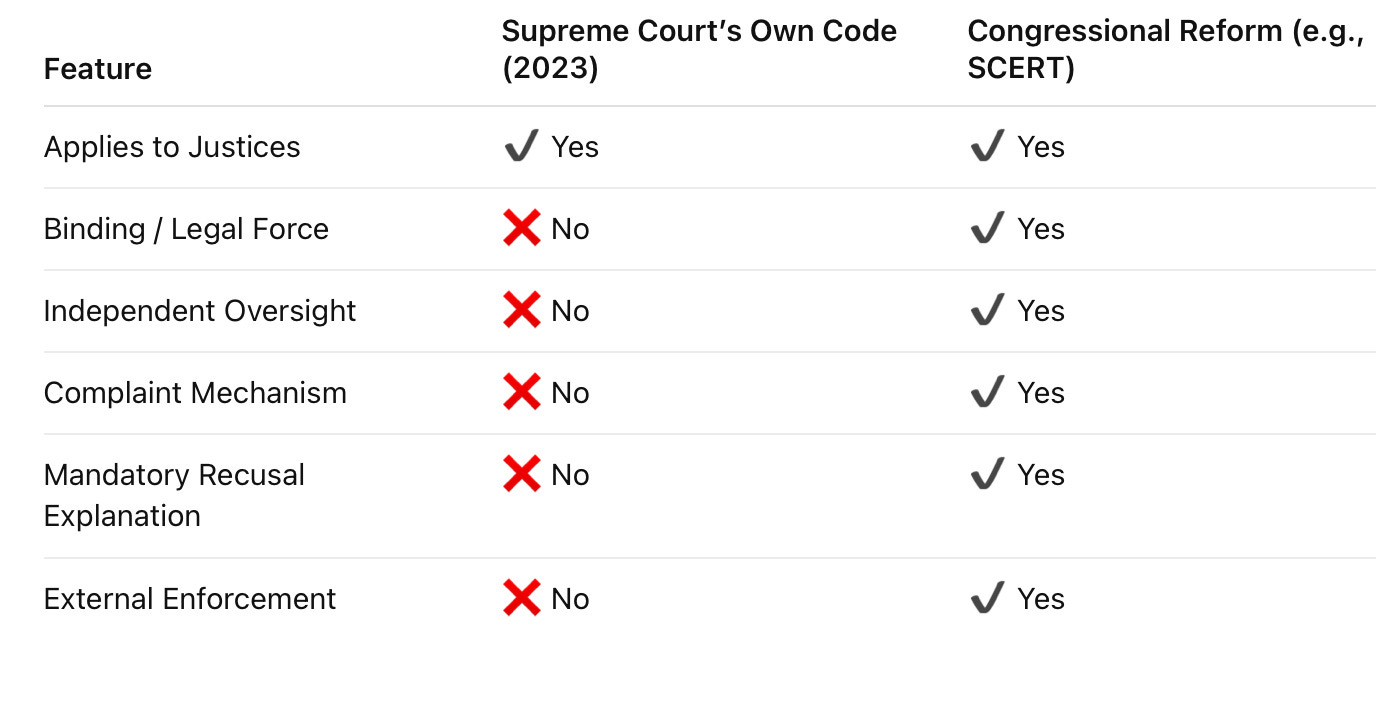
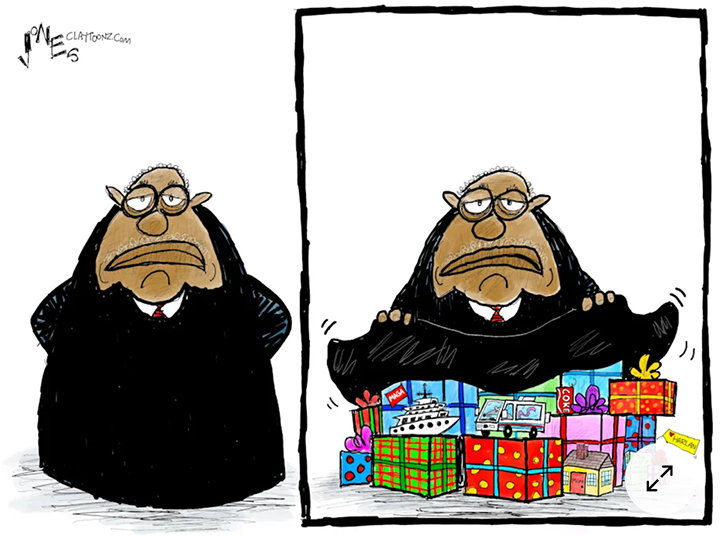
It changed almost nothing.
The code is:
Voluntary
Unenforced
Entirely self-policed
Without a complaint process
Without consequences
Lower federal judges are subject to ethics enforcement.
Supreme Court justices are not.
That is not judicial independence. That is immunity.
🤝 What You Can Do
You don’t need to be a lawyer to understand when a system is broken.
You can:
Pay attention not just to what the Court decides, but how it operates
Ask elected officials where they stand on binding judicial ethics
Support watchdog groups like Fix the Court and POGO
Share clear explanations instead of noise or outrage
Refuse to normalize the absence of accountability
Democracy does not collapse all at once. It erodes when guardrails are removed and no one is allowed to say so.
📚 References & Further Reading
Closing
A court without accountability doesn’t just fail the Constitution.
It teaches future leaders exactly how far they can go.
Thanks, the Justices have been allowed too often of late to use the ‘shadow docket’ to bypass accountability and to go against the Constitution. It’s time to sensor those Justices and get them off the bench for ‘ethics’ violations as well.
…great work, Francine!