The Supreme Court’s Long Shadow
How emergency rulings and one overlooked case reshaped election law

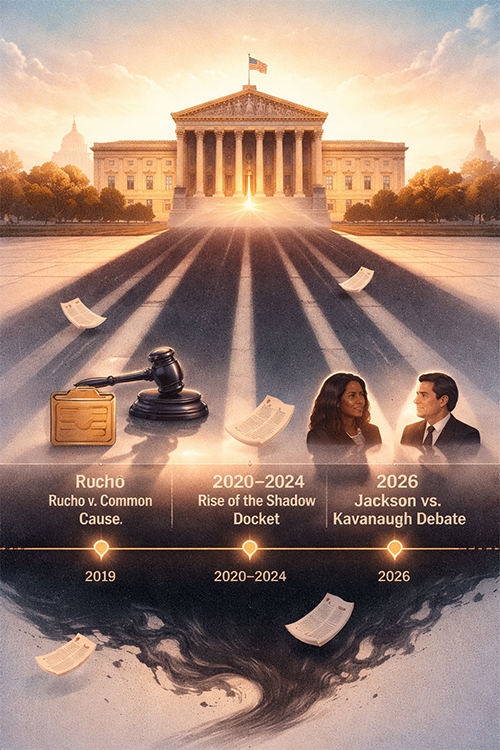
Few Americans realize how dramatically the Supreme Court’s role in election law has changed in the past decade.
In 2019 the Supreme Court quietly stepped away from one of the most contentious questions in American democracy: partisan gerrymandering.
Five years later, the Court is increasingly stepping back into election disputes — not through full decisions and arguments, but through emergency rulings issued in the shadows.
Increasingly, some of the most important decisions in American law now arrive without argument, without explanation, and without public attention.
This week that shift became visible in an unusual way: Two justices publicly disagreed about it.
A Rare Public Disagreement
At a legal event in Washington, Justice Ketanji Brown Jackson and Justice Brett Kavanaugh openly debated the Supreme Court’s increasing use of emergency rulings — often called the “shadow docket.”
Jackson warned that frequent emergency intervention can distort the judicial process.
“When the Court intervenes on the emergency docket without full briefing or explanation, it can create a warped environment for lower courts trying to do their jobs.”
Historically, the Court waited for cases to move through the normal appellate process before stepping in.
“The administration is making new policy ... and then insisting the new policy take effect immediately, before the challenge is decided. This uptick in the court’s willingness to get involved in cases on the emergency docket is a real unfortunate problem.”
That leaves the Supreme Court facing urgent requests to block or allow policies before the normal legal process has finished.
The Defense
Kavanaugh offered a different explanation.
In his view, the Court is not changing — the political system is.
“One reason we’re seeing more emergency applications is that presidents of both parties are governing more through executive orders.”
When policies take effect immediately, lawsuits follow just as quickly.
“None of us enjoys deciding cases on the emergency docket, but when an emergency application comes in, the Court has to decide.”
And Then It Happened Again
Almost immediately after that debate, the Court issued another emergency ruling affecting an upcoming election.
The Court blocked a lower-court order that would have required a congressional district in New York to be redrawn before the next election.
The ruling allows the current map — which benefits Republicans — to remain in place for now.
The decision came without a full opinion and over the dissent of the Court’s liberal justices.
Once again, the Court acted through the emergency docket rather than the normal process of briefing, argument, and written opinions.
The Quiet Turning Point
To understand why this matters, we have to go back to a decision many Americans have never heard of.
In 2019, the Supreme Court decided Rucho v. Common Cause. The Court ruled that federal courts cannot decide cases involving partisan gerrymandering.
Chief Justice John Roberts wrote that extreme partisan district maps may be unfair but are ultimately “political questions” beyond the authority of federal courts.
That decision removed one of the most important judicial checks on partisan map-drawing.
Election map challenges moved largely into state courts. But increasingly, the Supreme Court has stepped back into these disputes through emergency rulings — sometimes just before elections.
The Rise of the Shadow Docket
Legal scholars began noticing this shift several years ago.
One widely cited analysis by Supreme Court scholar Stephen Vladeck found that:
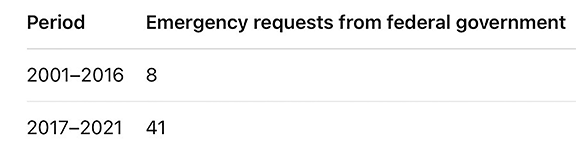
That dramatic increase changed how the Supreme Court affects policy.
Emergency rulings can now determine whether major policies take effect immediately, long before a case reaches a full decision.
Those policies have included disputes involving:
immigration
environmental regulations
public health rules
federal agency authority
election law
Often these decisions arrive without full explanation.
Why This Matters
Emergency rulings are not new. Courts have always had the authority to act quickly when necessary.
What has changed is how often those rulings now shape national policy. Through emergency orders the Court can:
allow major policies to take effect immediately
block lower-court decisions before appeals are complete
influence election rules shortly before voters go to the polls
Supporters say the Court is responding to urgent legal disputes.
Critics worry the Court is quietly reshaping American law without the transparency that normally accompanies Supreme Court decisions.
A Court Divided
The exchange between Jackson and Kavanaugh reveals that this debate is not only happening among legal scholars.
It is happening inside the Supreme Court itself.
Jackson’s warning reflects concern about the long-term health of the judicial process.
Kavanaugh’s defense reflects a belief that the Court is adapting to a faster and more polarized political environment.
The Constitution did not anticipate a legal system where major national disputes reach the Court almost weekly. But that is where the country now finds itself.
And increasingly, the Supreme Court is deciding those disputes in the shadows.
What Can We Do?
Structural changes in the courts can feel distant from everyday politics. But citizens still have several tools.
1. Stay informed
Much of the Court’s influence today happens through procedures most people rarely hear about.
Understanding concepts like the shadow docket helps citizens recognize how institutions evolve.
2. Support transparency
Some legal scholars and members of Congress have proposed requiring the Court to provide fuller explanations when issuing emergency orders.
Greater transparency would make it easier for the public to understand the Court’s reasoning.
3. Pay attention to judicial nominations
Supreme Court appointments are among the most lasting decisions presidents make.
Justices serve for life, meaning a single nomination can shape the law for decades.
4. Congress still has constitutional authority
Under the Constitution, Congress has significant power over the federal judiciary, including:
setting the number of justices
regulating the Court’s jurisdiction
establishing ethical rules for the Court
Those powers are rarely used, but they remain part of the constitutional system.
5. Impeachment (the constitutional backstop)
Yes — even that.
The Constitution allows impeachment of federal judges, including Supreme Court justices, for “high crimes and misdemeanors.”
It is extremely rare and politically difficult.
But it exists as the ultimate accountability mechanism in the constitutional design.
Closing
The most powerful changes in American government rarely arrive with headlines.
Sometimes they arrive quietly, in the shadows.
References
AP News — Coverage of Jackson/Kavanaugh discussion on emergency docket.
SCOTUSblog — Emergency docket analysis and case coverage.
Vladeck, Stephen — The Shadow Docket (Yale University Press)
Rucho v. Common Cause (2019) — Supreme Court decision on partisan gerrymandering.
U.S. Supreme Court orders on election map stay (2026 emergency ruling).
List of significant shadow docket decisions made by the United States Supreme Court.
Note: I never block paid or free subscribers from reading my whole posts and commenting.