The Vanishing Deductions
The How tax reform simplified life for the wealthy and complicated it for everyone else.


✳️ Remembering the Forms
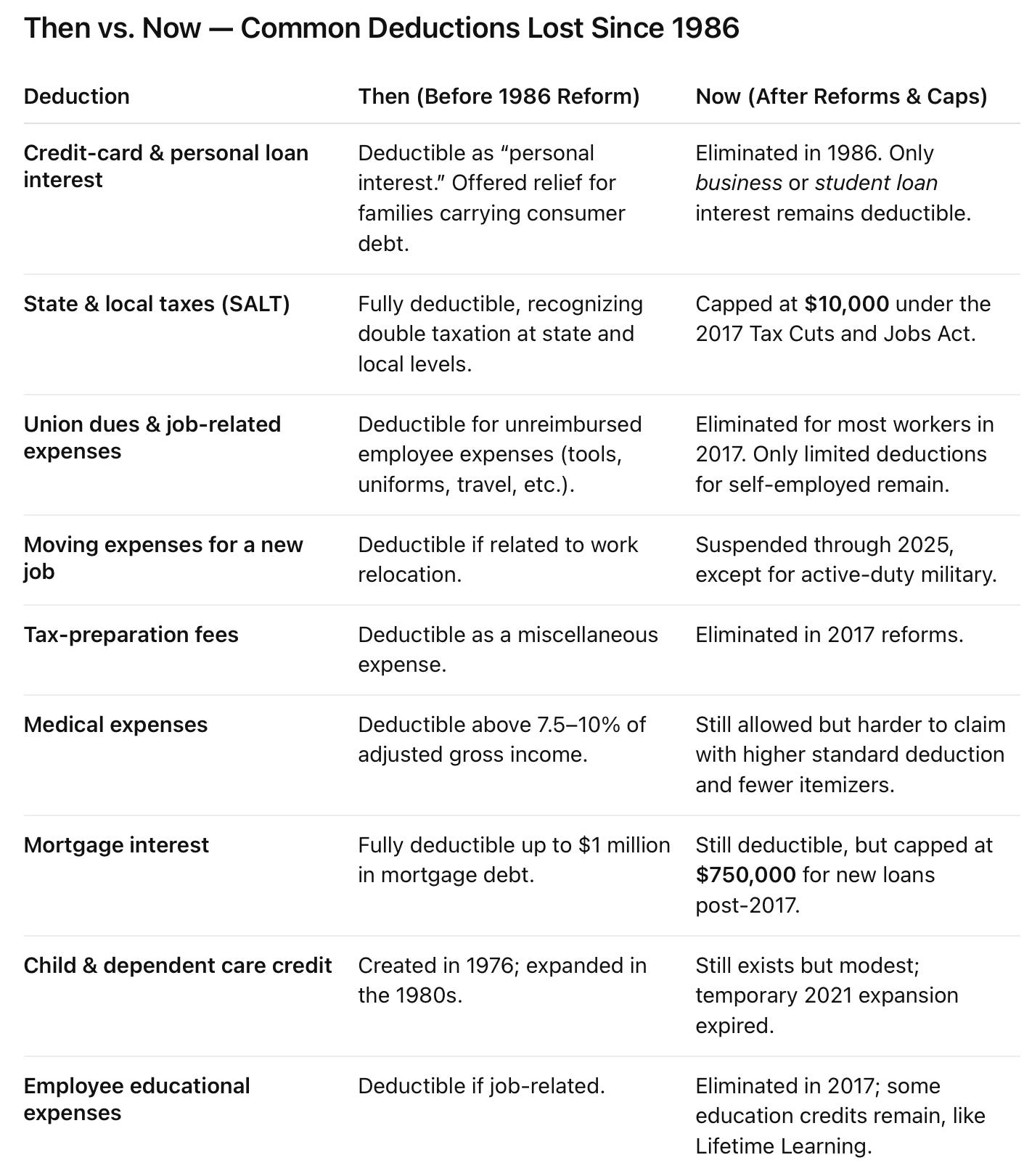
I remember when you could deduct the interest on credit cards — a small mercy for people who carried balances between paychecks. You could also claim what you paid in union dues, medical expenses, even the cost of preparing your taxes.
Every spring, those lines on the IRS form felt like recognition: the system saw you.
Then, year by year, that recognition faded in the name of “simplification.”
⚖️ The 1986 Turning Point
The Tax Reform Act of 1986 was sold as simplification. It lowered rates, flattened brackets — and quietly erased the deduction for personal interest, including credit-card debt. Mortgage interest survived; consumer interest didn’t.
That single change drew an invisible line between homeowners and everyone else.
Corporate loopholes stayed; individual relief vanished.
Soon other deductions followed — for moving, job-hunting, union dues, tax prep. The form looked cleaner, but the fairness didn’t.
💰 The Myth of Simplification
Each “reform” made filing seem easier while hiding what was really lost.
Flat rates and bigger standard deductions sounded fair, but they masked inequality rather than removed it.
The wealthy still filed complex returns — they just outsourced complexity. For everyone else, “simplicity” meant fewer chances to show what life really costs.
🏠 Winners and Losers
The winners of reform kept their incentives — mortgage deductions, investment write-offs, employer health plans.
The rest lost their footholds: renters, caregivers, teachers, small savers.
When I look back at old tax forms, what strikes me isn’t the math — it’s the recognition. Each deduction was a small acknowledgment that life costs money. One by one, those acknowledgments disappeared.
🧩 A Mirror of Deregulation
The same logic that gutted financial oversight reshaped the tax code — rules for some, freedom for others.
Deregulation privatized risk; tax reform privatized cost.
Each vanished deduction may seem small, but together they mark a shift in what fairness means. The tax code used to notice ordinary life — the interest we paid, the care we gave, the work it took just to stay afloat. When those lines disappeared, so did that recognition.
Maybe real reform isn’t about fewer boxes to check. Maybe it’s about being seen again.
Sources & Further Reading
• Wikipedia – the-tax-reform-act-of-1986
• Tax Policy Center – What The Ugly History of Tax Policy Over The Past Four Decades Means For The Future
• CRS Overview of the Federal Tax System crsreports.congress.gov/product/pdf/R/R43104
• CBO – Distribution of Major Tax Expenditures: cbo.gov/publication/43768
Powerful information. Thank you.
So true!!