What Can We Do When Privatization Threatens Democracy?
When democracy is outsourced, authoritarianism doesn’t arrive with marching boots. It arrives quietly — signed into contracts.

If privatization weakens democratic control and concentrates power in unaccountable hands, then the response is not abstract concern. It is deliberate.
Privatization becomes a form of fascism when corporate power replaces democratic oversight — when essential systems answer to shareholders instead of citizens.
What We Can Do (Structural + Civic Strategies)
1. Defend the commons — clearly and unapologetically
Some things must never become profit centers:
Water systems
Public schools
Libraries
Hospitals
Roads and bridges
Prisons
Elections infrastructure
Emergency services
If a service is necessary for life or democracy, it belongs in public hands.
2. Follow the ownership trail
Ask, and keep asking:
Who owns this hospital?
Who owns this utility?
Who owns this prison?
Who bought this housing complex?
Who profits from this contract?
Power hides in complexity. Transparency weakens it.
3. Expose euphemisms
Translate the language of privatization:
“Efficiency” → reduced care
“Choice” → narrowed access
“Public-private partnership” → public risk, private profit
“Streamlining” → cuts and closures
Language is one of the first warning signs of democratic erosion.
4. Support candidates who defend public institutions
In every state, some of the most important decisions happen locally:
School boards
City councils
County commissioners
Utility boards
Planning commissions
Privatization often enters at the municipal and state level long before it becomes federal policy.
What Your Readers Can Do — State by State
✅ Call or write state legislators
Find federal, state, and local officials:
https://www.usa.gov/elected-officials
Tell them clearly where you stand:
Phone script (state version):
Hello, my name is ______ and I’m a resident of this state. I’m calling to urge Representative/Senator ______ to oppose the privatization of essential public services — especially healthcare, water systems, prisons, and public schools. These must remain accountable to voters, not shareholders.
✅ Attend local government meetings
Across the states, city council and school board decisions frequently involve:
Charter expansion
Public asset sales
Service outsourcing
Development contracts
Even showing up silently changes the room.
✅ Ask officials directly
Email or ask at public forums:
Will you commit to opposing the privatization of essential public services and support keeping them publicly governed and transparent?
Make them answer in public.
✅ Support state-based public interest groups
Encourage readers to follow or support:
State policy institutes
Nonprofit investigative newsrooms
Public radio stations
Government transparency groups
Labor and civic coalitions
These groups track what citizens rarely have time to monitor alone.
✅ Form a Democracy Repair Circle
Three people is enough.
Purpose:
Monitor local proposals
Share research
Support public systems
Educate neighbors
Show up together
Small groups rebuild civic power.
A Citizen’s Pledge:
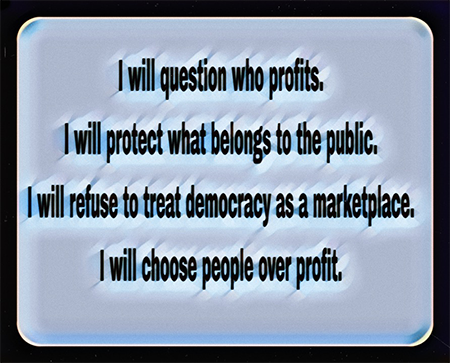
I will question who profits.
I will protect what belongs to the public.
I will refuse to treat democracy as a marketplace.
I will choose people over profit.
References & Further Reading
Foundational
Henry A. Wallace — The Century of the Common Man
On Privatization & Power
• Naomi Klein — The Shock Doctrine
• Wendy Brown — In the Ruins of Neoliberalism
• Mariana Mazzucato — The Value of Everything
• Chris Hedges — American Fascists
Democracy & Authoritarianism
• Anne Applebaum — Twilight of Democracy
Excellent!!