What Citizens United Changed: How Congress Now Works
Why fundraising now drives access, influence, and the writing of laws — the pen moved to moneyed interests

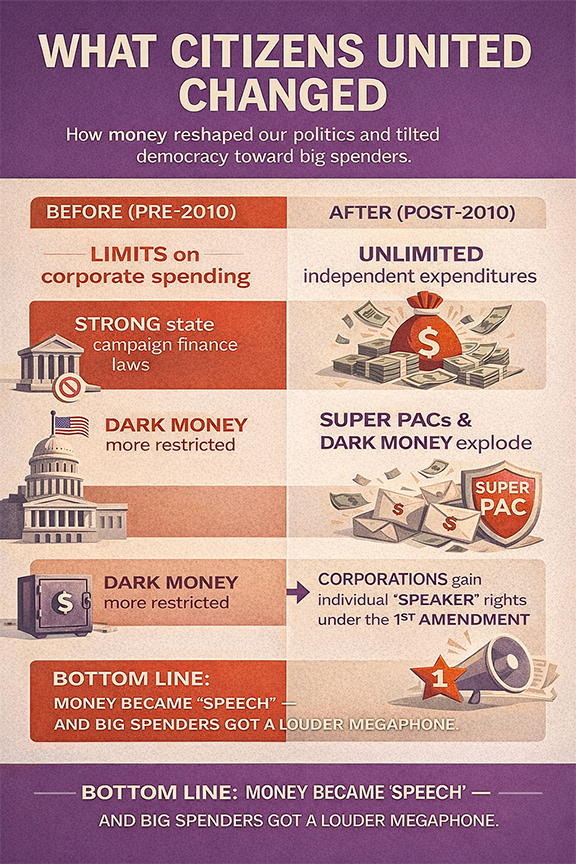
In an earlier post, I looked at who actually writes legislation in Congress — and how Citizens United reshaped incentives so that fundraising now dominates lawmaking.
This post looks at how power actually operates in American governance — not just through elections, but through money, courts, corporate influence, and the quiet rewriting of public rules. Rather than treating democracy as something that suddenly “breaks,” these posts trace how legal decisions, privatization, and institutional incentives gradually reshape who has access, who writes the rules, and whose interests prevail. The goal isn’t outrage, but clarity — and a better understanding of where democratic leverage still exists.
What Citizens United Changed
Citizens United didn’t just change campaign finance rules. It reshaped incentives, access, and time — pushing Congress away from governing and toward permanent fundraising. Once money became protected political speech, those who could supply it gained disproportionate access to lawmakers and, increasingly, to the drafting process itself.
But federal politics is only part of the story. When Congress becomes constrained by court doctrine and money, pressure doesn’t disappear — it moves. In a previous piece, I looked at what happens when states try to push back, and how quickly the courts step in to narrow the available lanes. Montana offers a clear example of both democratic resistance and its limits.
Montana’s approach doesn’t deny that Citizens United reshaped federal politics. It challenges a deeper assumption — that corporations are entitled to political power at all, rather than granted limited privileges by the states that create them.
Montana is saying:
“Political spending was never a corporate power the state granted in the first place.”
That’s a foundational argument, not a regulatory one.
Why This Matters
Citizens United reshaped the dominant incentives in federal politics, rewarding fundraising over governing.
When access depends on money, those who can supply it gain influence long before legislation reaches the floor. Lobbyists and industry groups don’t just react to bills — they often help shape them at the drafting stage, when definitions are written, exemptions are inserted, and enforcement is quietly weakened.
Over time, Congress adapts to this environment. Members spend more time raising money and less time governing. Staff rely more heavily on outside expertise. Ready-made legislative language becomes a shortcut in an overworked system.
This isn’t about individual bad actors. It’s about incentives. When fundraising becomes the price of access, lawmaking predictably tilts toward those who can afford to participate early and often.
📍 What Happens When States Push Back?
When federal incentives become this distorted, pressure doesn’t disappear — it moves to the states.
I looked at what that resistance looks like in Montana, where voters and courts collided over the limits of Citizens United — and why the outcome still matters.
→ When States Push Back — and the Courts Push Harder
What Montana Tried to Do About Citizens United (and Why It Still Matters)
Democracy doesn’t disappear all at once — it is reshaped by the rules we allow to harden without question.
What You Can Do
This isn’t a call to outrage. It’s a call to literacy.
Read the Montana Plan
Pay attention to how laws are written, not just how they’re branded.
Notice where money appears early in the process — before votes, hearings, or headlines.
Watch state-level efforts closely. When federal avenues narrow, states often become testing grounds for new arguments and new limits.
Remember that a vote for president is also a vote for federal judges — whose interpretations shape what reforms are even possible.
Clarity is not passivity. It’s the foundation for effective pressure.
References and Further Reading
Who Really Writes the Bills in Congress?
When States Push Back — and the Courts Push Harder
The Montana Plan Under the Plan, Montana would no longer grant its corporations the power to spend money in politics
Text of the Montana plan Initiative aims to curb political power through the state’s ability to grant charters
Transparent Election Initiative Explanation of the Montana Plan