When Accountability Breaks at the Top
What impeachment is for — and why it suddenly matters again

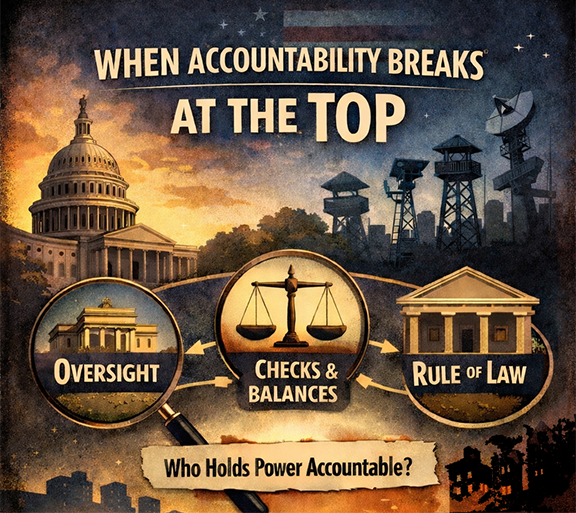
Lately, impeachment is back in the news — not only because of controversy around the Secretary of Homeland Security, but also because the President himself has been openly worried about what might happen if the House changes hands in the midterms.
That fear is revealing. It reminds us that impeachment isn’t just a cable-news drama. It’s a real constitutional mechanism. And it exists for moments like this — moments when normal lines of accountability start to break down.
Most people think impeachment is only for presidents. It isn’t.
The Constitution allows any “civil officer of the United States” to be impeached. That includes Cabinet secretaries — the people who run the largest and most powerful departments of government.
Impeachment is not a criminal trial. It is a constitutional tool for dealing with serious abuses of public power.
The process has two steps.
First, the House of Representatives votes on articles of impeachment. This requires only a simple majority. Think of this as a formal accusation — like an indictment. It does not remove anyone from office.
Second, the Senate holds a trial. Senators act as jurors. It takes a two-thirds vote to convict. If convicted, the official is removed from office and can also be barred from holding future office.
So:
Impeached = formally charged
Convicted = removed
The Constitution says impeachment is for “treason, bribery, or other high crimes and misdemeanors.” That phrase does not mean “only ordinary crimes.” It means:
Serious abuses of power, serious violations of constitutional duty, or serious betrayals of public trust.
Historically, that includes things like:
Defying Congress
Obstructing oversight
Corrupt or lawless use of authority
Turning government power into a political or personal weapon
Making part of the government unaccountable to the law
That’s why impeachment talk around the Secretary of Homeland Security is not about personality, tone, or ordinary policy disagreements.
The Secretary of Homeland Security runs one of the largest armed enforcement bureaucracies in the U.S. government. When Congress starts asking whether it can still get answers, still inspect what’s going on, or still hold that department’s leadership accountable, the issue becomes structural, not political.
It’s also important to say this plainly:
The President could fire the Secretary of Homeland Security at any time.
That is the normal mechanism. That is how the system is supposed to work.
Impeachment only enters the picture when:
The President refuses to act, and
Congress believes something fundamental about control of state power is breaking down.
This is not an abstract concern. We’ve seen this pattern before.
In countries like Hungary and Turkey, democracy didn’t disappear overnight. Elections still happened. Parliaments still met. Courts still existed. What changed was something deeper: the enforcement and administrative machinery of the state stopped answering to civilian oversight.
Once that happened, the system still looked democratic — but it was no longer self-correcting. Bad behavior stopped triggering real consequences. Power became insulated.
That’s the danger sign.
So this isn’t really about one person.
It’s about this question:
Can Congress still control the enforcement machinery of the federal government?
If the answer starts to become “no” — if Congress can’t compel testimony, can’t enforce subpoenas, can’t get answers, and can’t discipline leadership — then the accountability system itself is in trouble.
And that is exactly what impeachment was designed to address.
When the System Stops Correcting Itself
There’s one more reason this moment matters beyond any single official or any single department.
Over the past few years, we’ve been quietly building a system where accountability is harder and harder to enforce:
Immunity doctrines that shield officials from consequences
A shadow docket that allows major shifts in power without full argument or explanation
Standing and jurisdiction rules that keep courts from hearing cases at all
And now Schedule F, a plan to turn a professional civil service into a loyalty-based one
Each of these, on its own, can be defended as technical or procedural. Together, they point in one direction:
A government that is becoming harder to supervise, harder to restrain, and harder to correct.
That’s why impeachment exists in the Constitution. Not for revenge. Not for politics. But for moments when the normal control mechanisms stop working.
In Hungary and Turkey, democracy didn’t vanish overnight. Elections continued. Parliaments still met. Courts still existed. What failed was something quieter and more dangerous: the system stopped correcting itself.
That’s the line we should be watching here.
A democracy where the people’s representatives cannot control the people who enforce the law is no longer functioning as designed — no matter how normal everything looks on the surface.
What You Can Do
Call your representatives. Tell them you care about congressional oversight, not just party or policy. Ask them whether they support strong, enforceable oversight of the executive branch — especially over law enforcement and security agencies.
Suggested Call Script:
“I’m calling to ask the Representative/Senator to support strong congressional oversight and to oppose any effort to weaken civil service protections or block investigations into executive agencies. This is about keeping the constitutional accountability system working.”
Pay attention to oversight fights, not just elections. Oversight is where democracy either holds or quietly fails.
Support members of Congress who take oversight seriously, regardless of party. This is not a culture-war issue. It’s a constitutional one.
Watch what happens to civil service protections. Schedule F is not a technical change; it’s a structural one.
Be skeptical of “national security” arguments used to block courts, oversight, or transparency. That’s how unaccountable power always grows.
Talk about systems, not just personalities. The real danger is architecture that no longer corrects itself.
So ‘timely’ and thank you for reminding us that ‘Impeachment’ can be for any government worker: “The Constitution allows any “civil officer of the United States” to be impeached. That includes Cabinet secretaries — the people who run the largest and most powerful departments of government.”