When Food Becomes a Bargaining Chip: The SNAP Shutdown Confusion
Why millions don’t know if they’ll eat next week — and what that says about governance in 2025.

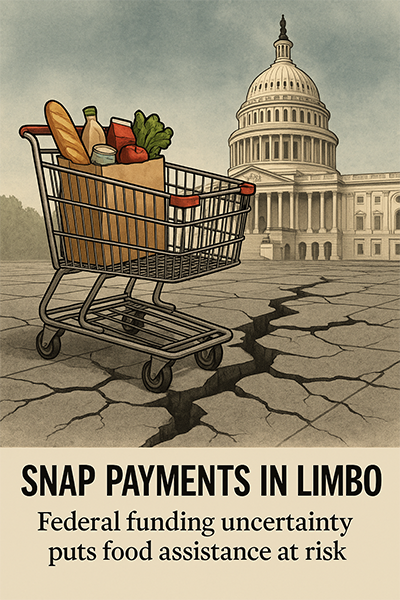
🌀 The Confusion No One Deserves
In early November, millions of Americans woke up not knowing whether their Supplemental Nutrition Assistance Program (SNAP) benefits — the modern food stamp system — would arrive in full, in part, or not at all.
After weeks of federal gridlock and a partial government shutdown, two judges ordered the administration to release funds. The result? A patchwork of mixed messages: some states promised 50 % payments, others said 65 %, and a few — including Michigan — prepared for full payments “when funds become available.”
The government’s job should be to ensure people can eat. Instead, the nation’s food safety net has become a pawn in a political power struggle.
⚖️ How We Got Here
SNAP isn’t discretionary — it’s a lifeline that moves money directly to families who need it, and it supports local grocers and farmers, too. Normally, it’s funded through annual appropriations from Congress.
But this year, amid a prolonged shutdown, those funds ran dry. The USDA scrambled to use a contingency account, enough for about half the usual benefits. Then a court intervened, ordering full payments — a decision the administration appealed.
By week’s end, headlines contradicted one another: “SNAP Fully Restored,” “SNAP Partially Funded,” and “SNAP Payments Delayed.” Each was true somewhere — and false somewhere else.
🍞 The Real Cost of Uncertainty
SNAP benefits aren’t just about groceries. They’re about predictability.
People budget around their monthly allotment; stores order inventory based on it; food banks fill the gaps when it’s late. When those payments wobble, everyone down the chain suffers.
Parents cut back meals to stretch food. Seniors on fixed incomes face hard choices. Local food banks see surges they can’t handle. And all of this because elected officials would rather posture than govern.
🏛️ A Bigger Pattern
This isn’t an isolated glitch. It mirrors what we’ve seen in health care, housing, and education: systems that once functioned as shared safety nets have been weakened through privatization, defunding, and deliberate neglect.
When public systems are destabilized, private players — from payday lenders to corporate grocers — step in to profit from the chaos. SNAP’s turmoil is one more example of governing by crisis.
💬 What You Can Do
Call your representatives (U.S. Senate and House): urge them to fund SNAP fully and permanently through a clean continuing resolution.
Support your local food bank — their shelves empty fastest during shutdowns.
Share reliable updates from your state’s human services department rather than social media rumors.
Stay engaged: these disruptions don’t happen by accident; they are the product of political choice.
The picture isn’t the same everywhere — some states are paying in full, others only halfway.
This snapshot shows how uneven the safety net has become as of this weekend.
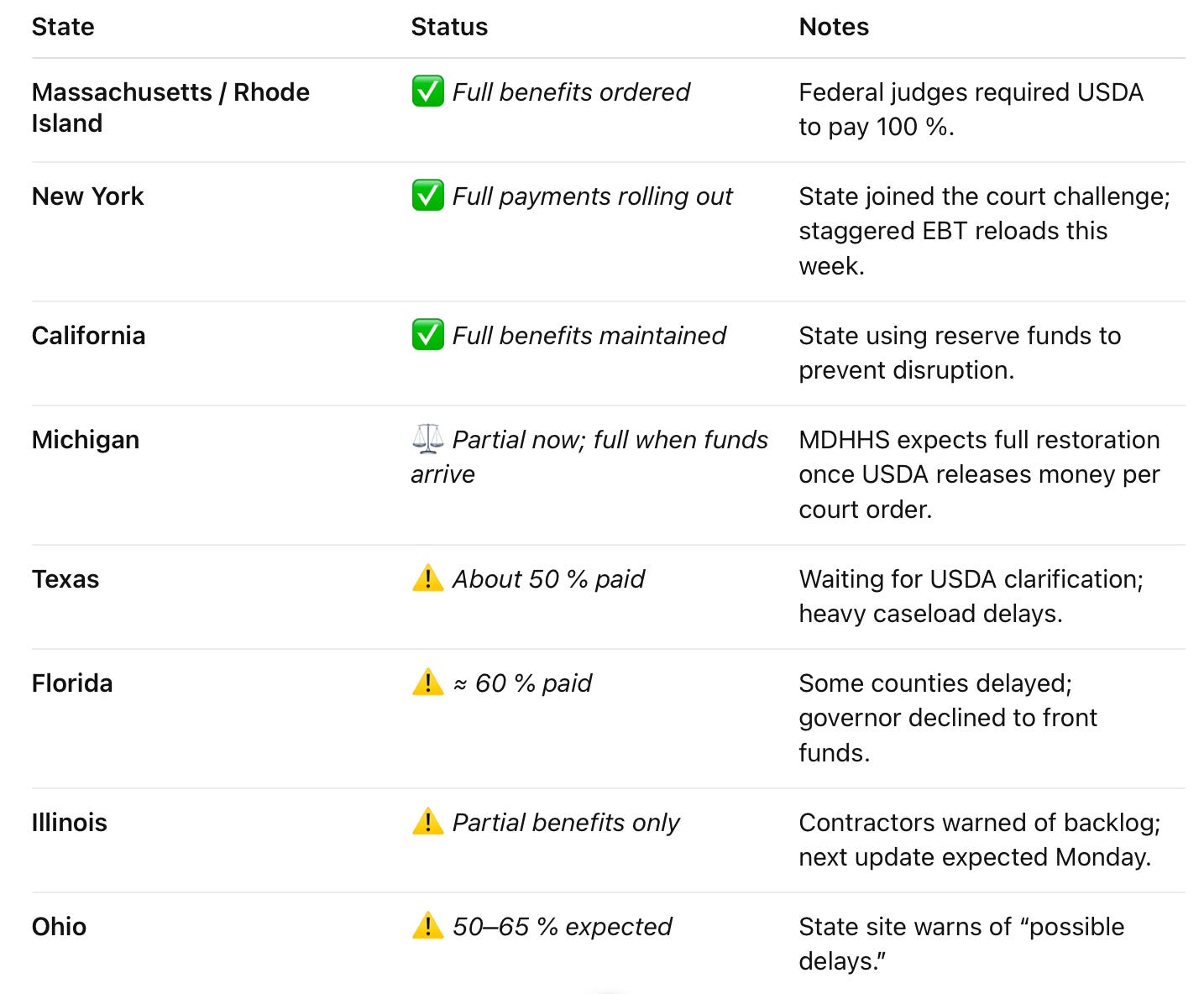
Note: This table highlights a sample of states to show the range of responses.
Each state’s situation is evolving; for the most current information, check your state’s official human or social-services site.
Summary:
SNAP payments vary widely — from full in the Northeast and West Coast to partial across much of the Midwest and South.
The differences reflect court rulings, state reserves, and political choices about whether to front federal money.
If the Justice Department’s appeal fails or Congress approves temporary funding, full November benefits could reach all states by mid-month.
Until then, the patchwork remains — a reminder of how fragile a “national” safety net becomes under shutdown politics.
🧾 A Note on Names
SNAP stands for the Supplemental Nutrition Assistance Program, the federal system that replaced “food stamps.”
Each state runs it under its own name, and EBT (Electronic Benefit Transfer) card — the debit-style card used to access monthly SNAP benefits.
Examples include:
Bridge Card (Michigan) | Lone Star Card (Texas) | Golden State Advantage (California) | Common Benefits Card (New York) | Link Card (Illinois), among others.
They all connect to the same federal program — the one now caught in political limbo.
📲 How to Check Your SNAP Benefits
SNAP recipients can verify their EBT balance, payment date, and benefit amount through their state’s official website or mobile app.
Visit your state’s Department of Human / Social Services portal.
Or call the toll-free number printed on the back of your EBT card for real-time account updates.
For the most reliable information, rely on official state-agency notices or USDA Food and Nutrition Service updates — not social media.
📚 References
Associated Press. “Trump administration says SNAP will be partially funded in November.” (AP News, Nov 3 2025)
Time Magazine. “Courts rule Trump must keep paying SNAP benefits during the shutdown.” (Time, Nov 5 2025)
Michigan Public Radio. “SNAP benefits will restart but will be half the normal payment and delayed.” (Michigan Public, Nov 3 2025)
CBS Detroit. “Michigan SNAP clients expected to get at least partial November benefits soon.” (CBS Detroit, Nov 4 2025)
www.dailylocal.com/2025/11/07/trump-government-shutdown-food-aid/
Illustration: Created in collaboration with ChatGPT / DALL·E, November 2025.
Until next time — may compassion lead policy, and may every table be full.
I have a EBT Bridge Card. I have recieved at least one text from MDHHS saying that I will receive benefits in November. Gov Whitmer has released 4.2 million dollars in Emergency funding and the Michigan Legislature is working on a bill to provide $7.4 million more. The Senate has passed this, but it is hung up in the Republican House. My regular benefits aren't much, but for those who are more dependent than I, I suggest you call your State Representive and ask them to vote in favor of the bill. My understanding is that the Supreme Court has given the First Circuit Court of Appeals 48 hours to rule on the Trump Administration's appeal to overturn the Federal Court ruling that full benefits be Paid. If the Appeal is upheld, that would mean half SNAP benefits will be paid and the USDA can claw back any and all benefits already paid out. I won't know if my $38/month will be mine for sure until Trump exhausts all his appeals.