When the System Makes Expansion Easier
Autonomous weapons are already embedded in modern defense. What is changing is the speed at which they are expanding — and who determines that speed.

Autonomous systems are not theoretical.
They already exist — in limited and often defensive forms.
Missile defense systems can automatically detect and intercept incoming threats within seconds. Counter-drone systems can identify and disable hostile drones faster than human operators can react. Unmanned aircraft and naval vessels can patrol and navigate with increasing independence. Many of these systems still retain human oversight.
The debate is not about whether autonomy exists.
It is about direction.
Defensive Autonomy vs. Expansion
Defensive autonomy has a clear logic:
Intercept incoming missiles.
Disable hostile drones.
Protect ships and bases.
React at machine speed when physics outpaces human response.
Few people argue against systems that prevent casualties.
But autonomy does not stay confined to interception. Software platforms scale. Systems integrate. Surveillance supports targeting. Coordination tools can become strike tools.
When executive procurement accelerates, when flexible contracting authorities expand, and when oversight weakens procedurally, the structure shifts.
The system now makes offensive expansion easier.
Not because it must happen.
Not because it has been announced.
But because the barriers to expansion are lower.
Executive Tempo and Private Alignment
Executive branches control tempo.
Private firms supply capability.
Doctrine follows deployment.
Major AI companies are already inside the national security ecosystem in various ways:
Microsoft holds significant U.S. Department of Defense cloud contracts.
Amazon Web Services provides classified cloud infrastructure to intelligence agencies.
Google has provided AI tools to defense programs; employees publicly protested its involvement in Project Maven.
OpenAI has acknowledged national security-related partnerships.
Palantir Technologies and Anduril Industries build systems directly integrated into defense operations.
Employees at several firms have publicly objected to military AI uses — not because autonomy is imaginary, but because they understand how adaptable these systems are.
Software built for surveillance can support targeting.
Autonomy developed for defense can integrate into offensive doctrine.
Defense contracts tied to national security are often not fully public in operational detail. That opacity is routine. But it narrows public visibility into scope.
When capability is scalable, oversight is thin, and procurement accelerates, direction becomes easier to shape from the top.
No conspiracy required.
Just capability + tempo + reduced friction.
How Oversight Is Supposed to Work
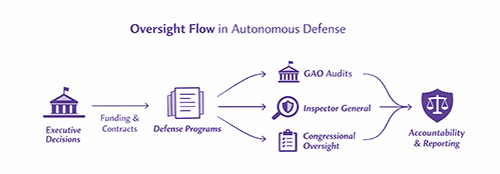
In theory, expansion moves through:
Congressional authorization (NDAA and appropriations)
Program review
U.S. Government Accountability Office audits
U.S. Department of Defense Inspector General investigations
Public hearings
Reporting requirements
Democratic systems were designed to slow force.
Oversight is friction.
How Oversight Gets Weakened
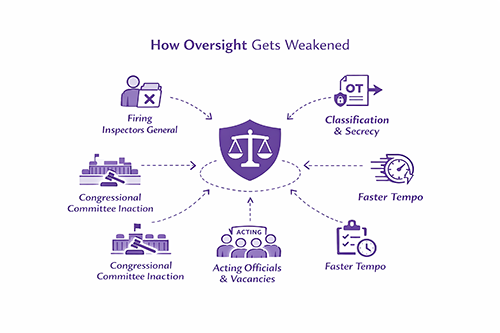
Oversight does not usually disappear.
It erodes.
Inspector General firings or vacancies
Committee inaction
Increased use of flexible contracting mechanisms like Other Transactions
Classification barriers limiting public visibility
Acting officials replacing Senate-confirmed oversight leaders
Individually, each is legal.
Collectively, they reduce friction.
Acceleration plus reduced friction changes outcomes.
What You Can Do
Oversight still has levers:
Watch budget language in the National Defense Authorization Act and appropriations bills. Ask what reporting requirements exist for autonomous systems.
Follow GAO audits. Ask representatives whether major autonomy programs have been reviewed.
Protect Inspector General independence. Oversight requires staffing and authority.
Ask about Other Transaction (OT) authority. Speed should not eliminate traceability.
Notice local footprint. Manufacturing plants, testing ranges, and data centers land somewhere.
Slowness is not inefficiency when lethal force is involved.
It is design.
The Core Tension
Autonomy is not new. Acceleration is.
When defensive systems evolve into scalable platforms, when procurement tempo increases, and when oversight mechanisms grow thinner rather than stronger, expansion becomes easier to direct from the Executive.
If friction fades while capability grows, the question is no longer whether autonomous systems exist.
It is who determines how far they go — and how quickly.
References
U.S. Department of Defense, Defense Innovation Unit (DIU) materials on rapid acquisition pathways
U.S. Government Accountability Office reports on defense acquisition and AI oversight
Public reporting on Project Maven and employee protests at Google
Department of Defense cloud contract awards to Microsoft and Amazon Web Services
https://federalnewsnetwork.com/federal-insights/2026/03/agencies-aim-to-harness-ai-for-cyber-defense/
Great info, Francine. Esp relevant given DoD severing ties with Anthropic over Anthropic’s safety restrictions on the use of its AI models.
Have you read about the rumors that US military leaders are selling the war on Iran as a holy war (precursor to Armageddon/Second Coming)?