Why Accountability Now Means Suing the Architecture, Not the Agents
What the Founders expected, what we’ve become, and how accountability has to change

There’s a video you can’t unsee.
A man — an ICU nurse — is shot again and again. In the back of the head. He was trying to help someone who had been pushed to the ground. He wasn’t attacking anyone. And afterward, an official stands in front of microphones and tells a story that simply isn’t true — even though we can all see what happened with our own eyes.
This is the moment when most of us ask:
Who did this?
And then: How can that person not be on trial?
There’s a moment when you watch the video and your body reacts before your mind does.
My first reaction was pure anger.
Anger at the person who pulled the trigger.
Even more anger at the official who lied.
And a special kind of anger at the theatrical display of power — the posture, the long coat, the performance of authority over a dead man.
And then this thought hit me:
If an ordinary person shot someone ten times in the back of the head, we would not be having a jurisdictional discussion. We would not be parsing doctrines. We would not be debating which court has authority. We would be calling it what it is.
The only reason we are not using that word here is because the shooter was a state or federal agent.
That’s the moral center of this whole story. And it’s also the beginning of understanding how far we’ve drifted from how accountability was supposed to work.
What would the founding generation have said about this?
They would not have said, “Let the executive sort it out.”
They would not have said, “Trust the agents.”
They would not have said, “This is just an unfortunate byproduct of enforcement.”
They were obsessed with three fears:
Standing armed forces
Unchecked executive power
Officials who can kill without being answerable to civilian courts
These weren’t abstract worries. They came directly from life under British rule.
🧠 The Founders’ core idea (in plain English)
Any government official who kills someone must be fully answerable to civilian law.
Not:
His own chain of command
Not secret review boards
Not internal investigations
Not “special doctrines”
Civilian courts. Juries. Open trials.
That’s why:
The military is (in theory) subordinate to civilian authority
The Constitution forbids quartering troops
The Bill of Rights is full of due process protections
The 3rd, 4th, 5th, 6th Amendments exist at all
They were trying to prevent exactly this: Armed agents of the state using force against civilians and then disappearing into immunity, secrecy, and executive protection.
⚖️ What they would have recognized immediately
If someone in 1789 said:
“A federal officer shot a man in the back of the head multiple times, and now we’re arguing about jurisdiction and immunity instead of holding a murder trial.”
They would have said something like:
“Then you no longer have a republic. You have an armed administration.”
📜 They were explicit about this
James Madison warned constantly about:
“The accumulation of all powers, legislative, executive, and judiciary, in the same hands… may justly be pronounced the very definition of tyranny.”
Alexander Hamilton (yes, that Hamilton) argued that:
The military must always be subordinate to civilian courts and law.
The entire design assumes:
Force answers to law
Law does not answer to force
🧱 How far we’ve drifted
What we have now is:
A vast armed federal apparatus
Broad executive discretion
Secrecy
Doctrines that protect agents from civilian courts
And endless “process” arguments instead of trials
That is almost the opposite of what they intended.
They would not have argued about:
Which court has jurisdiction
Whether the agent has immunity
Whether this falls under executive authority
They would have said:
Put the case in a civilian court. Let a jury decide.
The uncomfortable truth
Our system has changed so that individual law enforcement officers — especially federal ones — are now very hard to hold personally accountable.
This is not how it was designed to work. It is the result of decades of legal, political, and institutional drift.
Not because it’s right.
Not because it’s just.
But because we slowly built layers of protection around power.
Those layers didn’t appear all at once. They accumulated.
Courts invented immunity doctrines that do not appear in the Constitution.
Executive power expanded, especially under the language of “national security,” “emergency,” and “the border.”
Congress mostly failed to draw clear limits or reclaim its authority.
And over time, we normalized “special procedures” for things that used to go to ordinary courts.
What used to be:
A killing by an agent of the state must be answered in a civilian court
…became:
An internal investigation.
A jurisdictional fight.
A question of immunity.
A procedural maze.
Today there are layers of protection:
Legal doctrines that shield officers from being sued personally.
Rules that make it extremely hard for states to prosecute federal agents.
A Justice Department that almost never brings criminal charges against its own personnel.
Endless procedural and jurisdictional fights that can delay or kill cases before they ever reach a jury.
The result is something we’ve all seen over and over:
Even when a killing looks unjustified, even when video exists, even when the official story collapses, individual cases often go nowhere.
That doesn’t mean the harm wasn’t real.
It means the system has been reshaped to absorb it.
The moment where the story has to change
This is the point where most public conversations stall out.
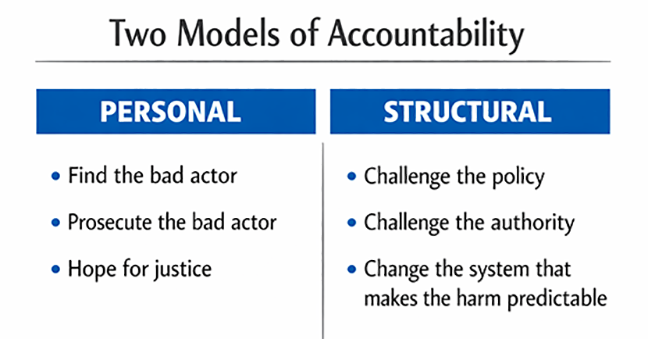
We argue about:
The shooter.
The liar.
The individual villain of the week.
That reaction is human. It’s also structurally insufficient.
Because even if one person is fired, or even charged, the system that produced the killing remains intact.
And that’s why accountability has started to shift. Not in our emotions — but in the law.
The key clarification
Here is the part that feels confusing, but is actually simple:
You usually can’t successfully sue or prosecute the individual agent.
But you often can sue the government, the agency, or the program.
Those are two different kinds of cases.
Families can sometimes sue the United States government for wrongful death. That doesn’t put anyone in jail, but it can:
Force official findings
Force disclosure of facts
Force policy changes
And cost the government real money
Groups like the ACLU and others more often bring structural cases. These don’t ask:
“Is this one agent guilty?”
They ask:
“Is this program lawful?”
“Is this authority constitutional?”
“Are these rules of engagement legal?”
“Is this secrecy and lack of oversight allowed?”
And courts can answer those questions.
They can:
Block certain practices
Force new rules
Require transparency
Put agencies under court supervision
Change what the system is legally allowed to do
You can’t easily put the shooter on trial.
But you can sometimes put the machinery on trial.
Why this is the only path that actually changes anything
History is very clear about this:
Systems do not change because one person is punished.
They change because rules are rewritten.
Civil rights progress in this country has come from:
Injunctions
Consent decrees
Court-ordered reforms
Statutory changes
Ongoing judicial oversight
Not from one-off prosecutions.
That’s not emotionally satisfying. But it is how power actually gets constrained.
The Minnesota case is a perfect example
What’s happening there is already bigger than one shooting.
There are fights over:
Who controls the evidence
Who gets to investigate
Whether federal agencies have to cooperate with state authorities
Whether these operations are even being conducted under lawful authority
That’s not a distraction from justice.
That is where structural accountability begins.
The deeper truth
Our legal and political system has been built — and then reshaped — so that:
Individuals are protected. Systems are protected. And harm is treated as an unfortunate byproduct.
If we keep aiming our anger only at the person holding the weapon, the building never changes.
And the building keeps producing the same outcome.
What You Can Do
Demand statutory limits on immunity. These doctrines are not laws of nature. Congress can change them.
Support organizations that bring structural cases, not just individual ones (ACLU, Brennan Center, Institute for Constitutional Advocacy & Protection, etc.).
Call your members of Congress about:
DHS and federal enforcement authority
Emergency powers
Independent prosecutors for law enforcement killings
Stop accepting “investigation pending” as an answer. Demand timelines, transparency, and outside oversight.
Share structural explanations, not just outrage. Outrage burns out. Understanding changes rules.
The closing truth
You don’t fix a collapsing building by arresting the last brick that fell.
You fix the design.
Or the building keeps collapsing.